
Scrub Oak Removal And Pruning, Parker
Not every oak stand in Parker needs to die. Plenty just need discipline: lifted off the ground, thinned to daylight, and shaped so they read as landscape instead of fuel. I do both ends of that spectrum in The Pinery, Stonegate, and along the Hess Rd corridor, and I'll tell you honestly which end your thicket belongs on.
A CHOICE
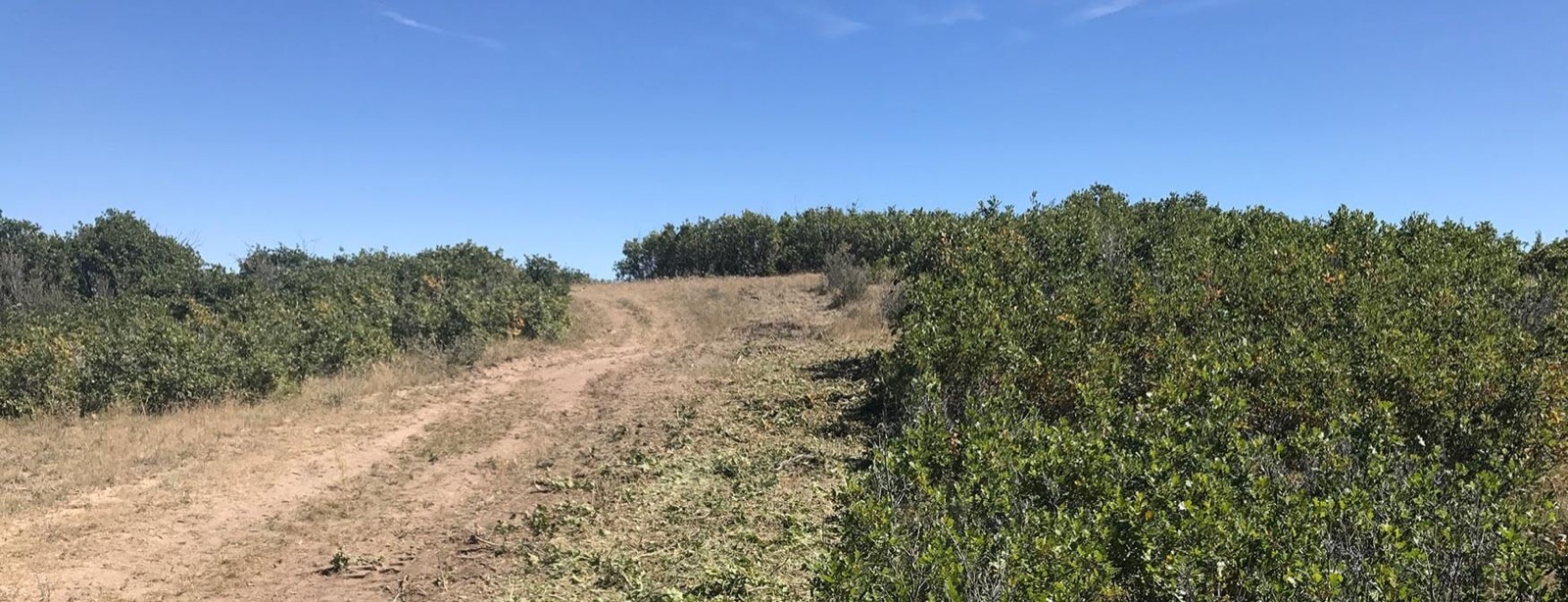
Keep the Oak. Lose the Hazard.
Most contractors treat Gambel oak as a demolition target. I don't, and Parker is the town that taught me why. Out here the oak often IS the landscaping: mature clumps that screen a neighbor's second story, shade a patio in August, and turn honest gold every October. Ripping all of it out solves the fire problem and creates a privacy problem, a resale problem, and a view of the fence you planted it to hide. The better question is which stems earn their place and which are just fuel.
That's the removal-versus-pruning decision, and it's a real fork in the road. Pruned oak is oak you commit to maintaining. Removed oak is oak you commit to mowing regrowth on. Both are legitimate. What's not legitimate is a ten foot thicket touching your deck and getting called landscaping.
Parker's price point sharpens the stakes. Mature vegetation is a real slice of home value in these neighborhoods, and oak that took forty years to reach its size can't be bought back from a nursery at any price. So I treat removal as the irreversible option it is on the visible half of a lot, and save the aggressive grinding for fuel nobody would miss. You can always remove more later. You can't un-grind a screening thicket you wish you'd kept.
THE CRAFT
Lifting, Thinning, and Shaping a Stand
Pruning oak for fire behavior comes down to three moves. Lifting means removing the lowest branches and the dead interior stems, so there's clean air between the ground and the live canopy and a surface fire finds no ladder. Thinning means taking out the weakest stems in each clump, cutting the density until light hits the ground between them. Shaping means cutting the stand's outline back off structures, walkways, and property lines, with real separation between clumps rather than one merged mass.
Done right, you keep maybe the best third of the stand and it looks intentional, almost orchard-like. The dead stuff and the litter underneath, which is the most flammable material in the whole system, goes through the mulcher and comes back as ground cover. The clumps that remain are healthier for the thinning, since the clone stops feeding forty weak stems and concentrates on ten good ones.
Litter management is the unglamorous half of pruning work. Oak drops leaves that mat up under the canopy year after year, and that duff layer plus the dead interior wood is where embers find their purchase. When I finish a pruning job, the ground beneath the kept clumps is cleaned and mulched, and I'll show you what an annual tidy-up under them involves so the stand stays as safe as the day I load the machine.
THE CALL
When Pruning Stops Making Sense
I'll argue for keeping oak where it's keepable, but some stands are past that point. Here's roughly how I call it on a walk-through:
- Oak within about fifteen feet of the house: remove, no debate
- Overgrown thicket with mostly dead interiors: remove and let it restart clean
- Healthy clumps with room around them: prune, lift, and keep
- Oak on the far side of the lot threatening nothing: thin lightly or leave alone
- Stands under stressed pines: remove, because that ladder matters most
Sometimes the honest answer is a mix: masticate the back half, hand-prune the showpiece clumps near the patio. And because the roots survive either treatment, a removed stand can be regrown and shaped later if you change your mind. Oak forgives almost everything except neglect.
LOCAL GROUND
The Pinery, Stonegate, and the Hess Road Corridor
Parker's oak country concentrates in the older treed neighborhoods. The Pinery carries it under mature ponderosa, where pruning and understory removal often happen in the same visit. Stonegate and the newer developments have oak preserved in greenbelt fingers that back onto private fences, where the work is mostly edge control and lifting. And along Hess Rd and the southern edge of town, lots get bigger and the oak gets wilder, closer to open rangeland brush than suburban planting.
Each setting gets a different mix of machine and handwork. The mulcher does the heavy removal fast and clean, and hand pruning handles everything the machine shouldn't touch. Having both on one job, from one operator, is the point. You're not coordinating a tree service and a clearing contractor who've never met.
Pruning also carries a horticultural calendar that removal doesn't. Heavy shaping is easiest on the plant, and on me, during dormancy, roughly late fall through early spring, when the structure shows plainly with the leaves down. Light lifting and deadwood can happen anytime. What I avoid is hard cutting during the spring flush, when the clone is spending its reserves on new growth. Mastication has no such season. The machine wins twelve months a year.
BOOKING
Getting an Honest Read on Your Parker Oak
The walk-through costs nothing and comes with opinions. I'll flag what I'd remove, what I'd prune, what I'd leave, and what each piece costs, and you pick the scope that fits your budget and your attachment to the brush. I'm out of Larkspur, an easy run up Highway 83, and I take cash and checks. Winter is a fine time for this work, by the way. The structure of a stand is easier to see with the leaves off.
Request a visit through the free quote page. If you want to see finished examples first, the projects page shows both full removals and selective work, which makes the difference easier to picture on your own lot.
Free Quote · No Obligation
Clear the fuel before fire season, not during it
Or call the shop: (719) 400-9104