
Scrub Oak Removal
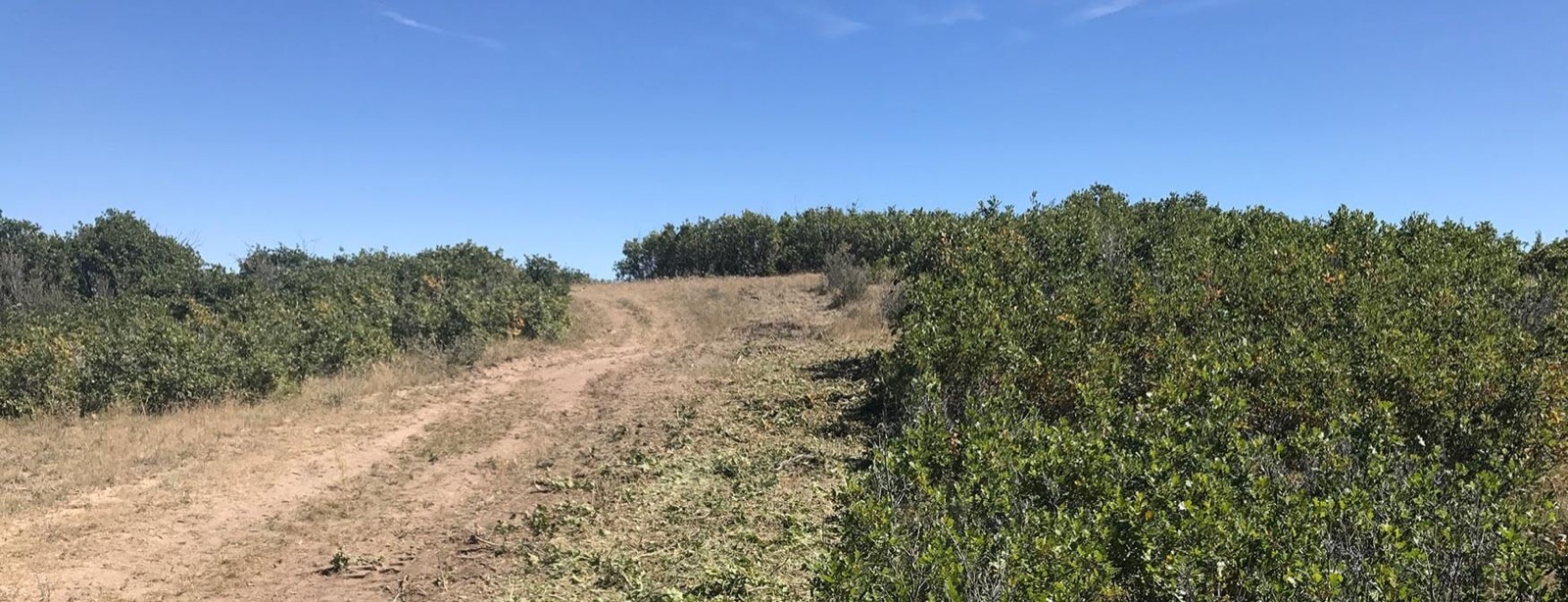
Gambel oak is beautiful on a far hillside and a genuine fire hazard against your house. It grows in dense, oily thickets that burn hot and come back from the roots after every cut. We grind it flat with a mulcher and set up the follow-up that actually keeps it down.
Quercus gambelii
Why scrub oak keeps coming back
A scrub oak thicket isn't a bunch of separate shrubs. It's usually one connected organism, joined underground by woody root crowns called lignotubers that store years of energy. Cut every stem to the dirt and those roots push back thicker than before, which is why hand-cutting or mowing a thicket just farms denser oak for next season. It also explains why the fuel load climbs even as you keep hacking at the top. Fighting Gambel oak with a chainsaw is a workout you lose.
Why it's such a serious fire fuel
Gambel oak burns hot. The leaves and small stems hold oils that ignite fast, the thickets grow dense and continuous, and they cure into a connected bed of fine fuel that carries fire across a slope and straight into whatever's at the top, usually a deck or a wall. On the Front Range, scrub oak against the house is the single most common reason a defensible-space plan starts with oak removal. It's the fuse, and it's the one most people have the most of.
How we handle it
The mulcher grinds the thicket down to a chip layer, stems and root crowns, in one pass. That knocks the standing fuel to zero and buys immediate defensible space, the same day. The ground comes out covered in a mulch layer that holds soil on the slope instead of the bare, erosion-prone dirt a dozer-and-pile job would leave. For lasting control we talk about the follow-up: targeted regrowth treatment or a repeat mulching pass on a cycle, because one grind alone won't kill a root system that deep. Where you want to keep some oak for screening or wildlife, we leave shaped clumps with space around them instead of a continuous fuse.
The scrub oak process
Thicket to defensible ground
- Assess the thicketWe look at density, slope, and how close the oak sits to structures, and mark what comes out and what stays.
- Grind in one passThe mulcher takes stems and crowns down to a mulch layer. Standing fuel gone the same day.
- Plan the regrowthWe set up the follow-up, targeted treatment or a repeat pass, so the oak stays down instead of rebuilding.
- Keep it managedA light maintenance visit every few years holds the ground. Far cheaper than letting the thicket return.
Timing matters
We do the heavy oak work in fall and winter when the ground is firm, fire danger is low, the oak is dormant, and the machine leaves the lightest footprint. Dormant-season grinding also sets up the cleanest regrowth control, because the roots are drawing down instead of pushing hard. For homes in the wildland interface, this pairs directly with defensible space work and wildfire mitigation, and it often qualifies for county mitigation cost-share. Ask and we'll point you at the programs running in your county this year.
Common Questions
Questions we get about this work
Will the scrub oak grow back after you mulch it?
Can you kill it permanently?
It's on a slope behind my house. Can you still do it?
Should I keep any of it?
Does mulched oak become a fire hazard on the ground?
Free Quote · No Obligation
Scrub oak season is when the ground is firm and the risk is low
Or call the shop: (719) 400-9104