
Forest Thinning & Fuel Reduction
Thinning is the acreage version of defensible space. On wooded lots and ranch ground we open up crowded stands, cut the ground and ladder fuels that carry fire, and mulch the debris where it lies. The forest that's left is healthier, more open, and far harder to burn.
Fuel Reduction at Scale
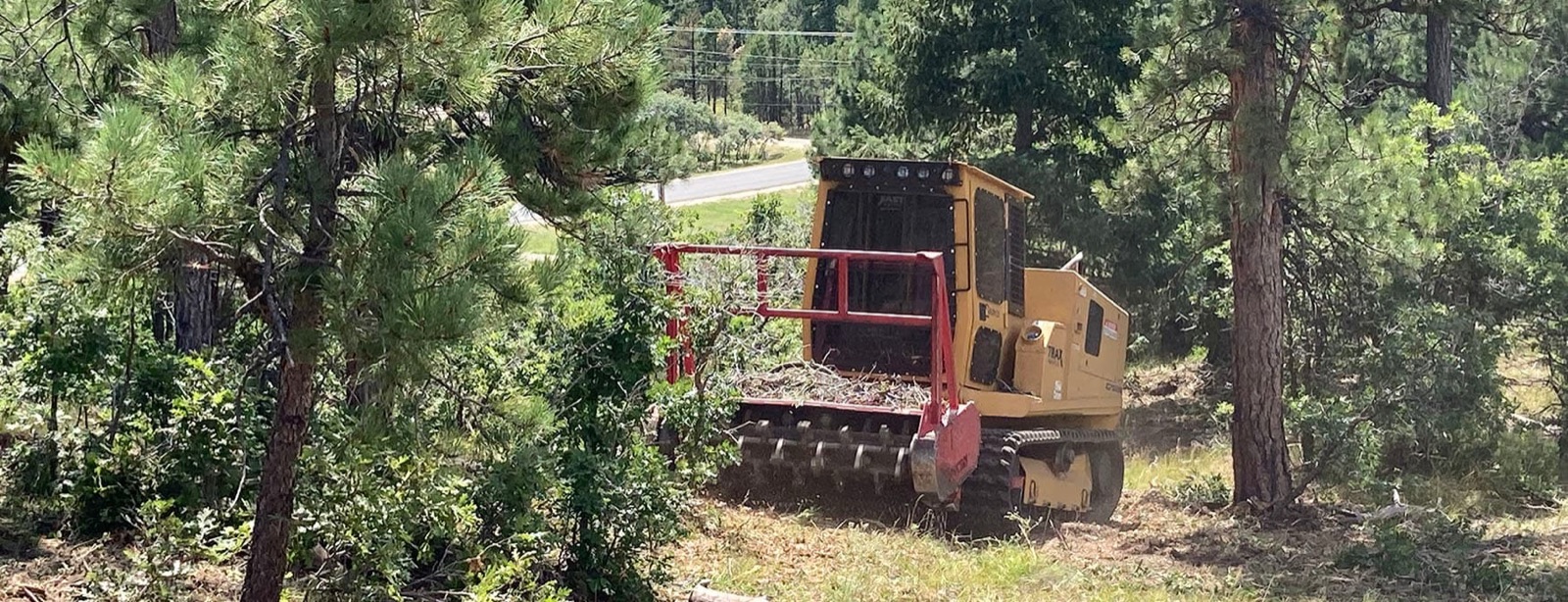
Thinning versus clearing
Thinning isn't clearing. The goal isn't bare ground, it's a forest with breathing room. We take the crowded, the suppressed, and the dead, and we leave a stand of well-spaced healthy trees with open ground and reduced fuel between them. Done right, you keep the shade, the wildlife habitat, and the look and feel of a forest while stripping out the fuel that turns a survivable ground fire into a catastrophic crown fire. Think of it as defensible space applied to acreage instead of a yard.
Ground fuel and ladder fuel
Two kinds of fuel decide how a fire behaves once it reaches your land. Ground fuel is the brush, deadfall, and cured grass a fire creeps and builds in. Ladder fuel is the low branches, saplings, and scrub that let it climb from the ground into the tree canopy. Once a fire is in the crowns it's nearly unstoppable and it throws embers far ahead of itself. We cut both kinds of fuel. Drop the ladder and open the spacing, and a fire that reaches your acreage stays on the ground, where it's slower, cooler, and something crews can actually get in front of.
Crown spacing is the whole game
The single most important thing thinning does is put space between tree crowns. A fire in a dense stand jumps canopy to canopy without ever touching the ground, moving as fast as the wind. Break that continuity, give the crowns room, and you take away the fire's fastest path. That's why a properly thinned stand can survive a fire that levels the overgrown parcel next door. It's also why thinning and forest health are the same job: the spacing that stops fire is the spacing that gives each tree enough water to resist beetles and drought.
How thinning runs
Choked stand to defensible acreage
- Assess and prioritizeWe read the fuel, slope, and structures, and mark the priority zones that protect what matters most first.
- Plan and priceYou get a written scope and a firm number, plus any cost-share options, before work starts.
- Selective mulchingThe machine removes ground and ladder fuel and opens crown spacing, leaving your best trees.
- Phased if neededOn big acreage we treat priority ground first and extend outward as budget and grants allow.
Cost-share and grants
Fuel-reduction work on private land often qualifies for cost-share through county programs, fire districts, and state forest-health grants, because your thinned acreage protects the whole neighborhood and watershed, not just your house. Those programs exist because your work makes everyone downwind safer. We'll tell you what's available in your area, scope the project to fit the program's requirements, and phase larger jobs so the priority ground gets done first. Bigger jobs run statewide; smaller residential parcels tie right back to defensible space and forest restoration.
Common Questions
Questions we get about this work
How is thinning different from clearing?
How much of my acreage should be thinned?
Can a mulcher work my wooded acreage without damaging the trees I keep?
Is this grant-eligible?
What size property makes sense for thinning?
Free Quote · No Obligation
Thin the acreage now while the ground is firm and the crews are open
Or call the shop: (719) 400-9104