
Scrub Oak Removal in Larkspur
My shop sits at 9133 Frink Rd, so every oak job in Larkspur is a short drive from where I park the machine. I've ground scrub oak off slopes in Perry Park, Sage Port, and Bear Dance for years, and I know how this red-rock ground behaves under a tracked mulcher. This is home turf work, priced like it.
HOME TURF
The Oak Job Down the Road From My Shop
My shop is on Frink Rd, a few minutes from downtown Larkspur, and most of the oak I grind stands within fifteen minutes of it. Perry Park, Sage Port, Bear Dance, the ridges off Spruce Mountain Road. I don't quote Larkspur jobs off a satellite photo. I've usually driven past the property a hundred times, and half the time I already know what that particular hillside of oak looks like in a dry July. When the machine working above your house belongs to a neighbor, the work tends to get done like a neighbor's watching. Because one is.
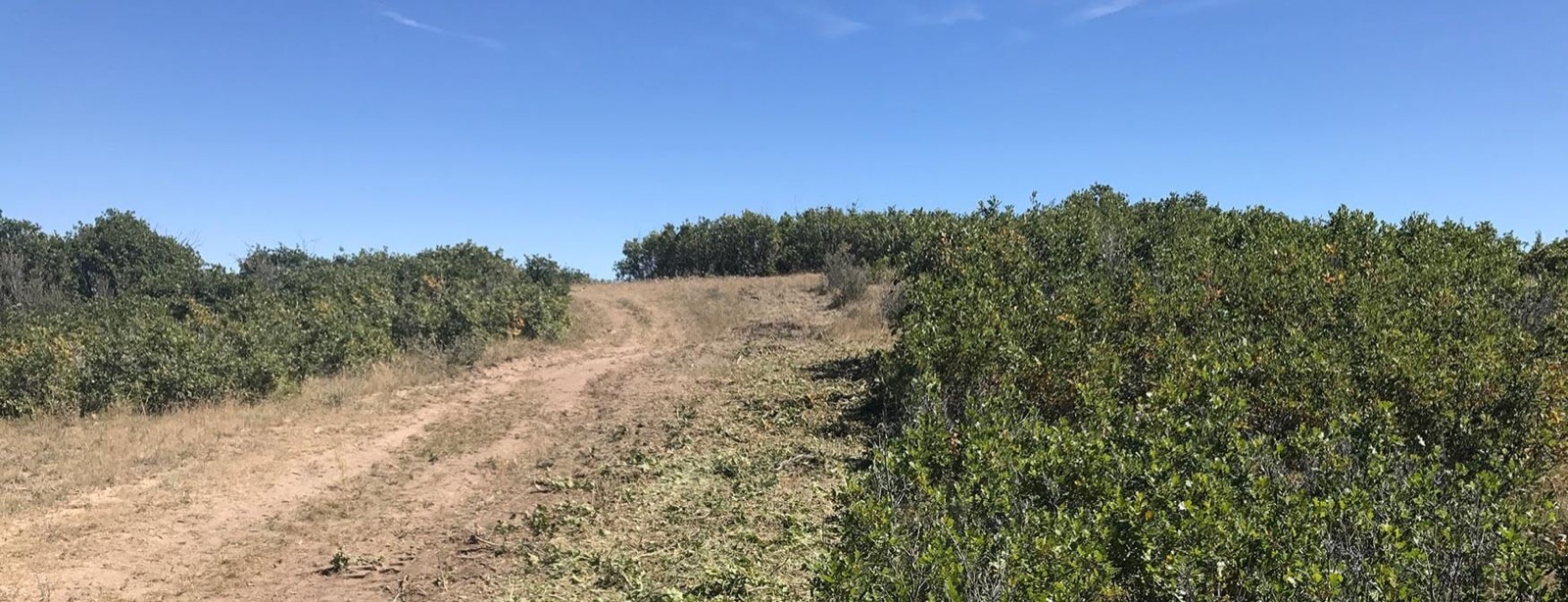
Larkspur oak runs thick. The draws between the red rocks hold moisture, so Gambel oak here grows taller and denser than the stuff out east. Ten and twelve foot stems, packed tight, walking right up to decks and propane tanks. And since most lots around here back onto slopes, that brush sits uphill or downhill of the house, exactly where fire behaves worst. Grinding those stands back to a survivable spacing is the bulk of what I do all year.
STEEP GROUND
Slopes, Red Rock, and Where a Machine Can Go
Perry Park's sandstone spires are gorgeous right up until you have to work around them. Lots out there roll hard, break into ledges, and hide loose decomposed granite under the grama grass. I run a tracked Rayco forestry mulcher with low ground pressure, and I've spent years learning which pitches it holds and which it doesn't. Steep doesn't bother me. Stupid does. If a slope is beyond what the machine can safely work, I'll say so on the walk-through and we'll figure out an honest alternative for that section.
Tracks matter for a second reason: they don't tear ground apart. On a grade, a wheeled machine or a small dozer cuts ruts that turn into gullies after one August thunderstorm. The mulcher walks the slope, grinds the oak where it stands, and leaves the root mat in place holding soil. The mulch blanket softens rain impact on top of that. On Larkspur's erodible red soils, that detail is worth real money the first monsoon season after the work.
THE BIOLOGY
Cutting Oak Is Easy. Beating It Takes a Plan.
Gambel oak grows as a clone. The stems you're looking at are shoots off one shared root system, fed by underground lignotubers that were there before the subdivision was platted. Saw it flat and it resprouts, often thicker than before. So I don't sell eradication. Nobody can sell that honestly. What mastication does is reset the stand to ground level, convert ten feet of ladder fuel into a mulch bed, and put you in charge of what grows back. Regrowth comes in soft and low, and a periodic follow-up pass keeps it that way.
The real goal on a Larkspur lot is separation. Oak pushed back from the structure, islands instead of one continuous thicket, gaps wide enough that ground fire can't hand itself along. Kept low and broken up, oak still earns its keep: deer browse it, turkeys nest in it, and the clumps hold snow into spring. I'd rather hand you back a property that still looks like Colorado than a scraped pad with a view of stumps.
THE FINISH
What Grinding Leaves on Your Ground
Everything gets processed in place. No burn piles waiting two years for a permit window, no dump trucks hauling brush down Perry Park Avenue, no slash stacked against the back fence. The head chews stems into chips and scatters them across the footprint of the work. What's left looks rough for a few weeks, then settles into a quiet brown carpet that smells like a sawmill and keeps the weeds down while native grass moves back in.
People ask whether the mulch itself is a fire problem. Laid flat and a few inches deep, it burns poorly compared with standing oak, which carries flame vertically into the canopy. A compact ground layer that smolders is a fight a homeowner and a garden hose can win. A ten foot wall of oily oak leaves at the end of a hot wind is not.
Timing's flexible. I grind Larkspur oak year-round, and winter has real advantages: frozen ground, dormant grass that bounces back untouched, and a calendar that's easier to get on. Fall books heavy too, once owners have spent a whole summer watching the thicket and worrying. The only stretch I'd counsel patience on is the muddy heart of spring runoff, when even tracks can mark up a saturated slope. Beyond that, the machine works in weather that would cancel a hand crew, and a January job protects you just as well in June.
NEXT STEP
Getting on the Schedule From Bear Dance to Sage Port
First step is a walk-through. I look at access, slope, stem size, and what you want the finished property to look like, then give you a firm number. No sales manager, no crew of strangers, just me and the machine I own and maintain. Most residential oak jobs in Larkspur run one to three days. I take cash and checks, and I'll put the scope in writing so there's zero confusion about what gets ground and what stays standing.
If you're near Bear Dance or on the Sage Port side of the interstate, I can often fold your job into a week I'm already working nearby, which trims your mobilization cost to almost nothing. Start with a free mitigation quote, or call (719) 400-9104. And if the wider concern is the whole homesite rather than one thicket, look over my defensible space work for the south metro area before we walk your lot. It'll sharpen the conversation.
Free Quote · No Obligation
Clear the fuel before fire season, not during it
Or call the shop: (719) 400-9104