
Scrub oak removal in Colorado Springs
The west side of Colorado Springs runs uphill into oak brush, and the neighborhoods along that seam carry more wildfire exposure than almost any city ground in Colorado. I grind Gambel oak on steep lots in Cedar Heights, Mountain Shadows, and Peregrine with a tracked mulcher built for exactly this terrain. Waldo Canyon showed what's at stake. The oak is the part you can change.
CITY EDGE
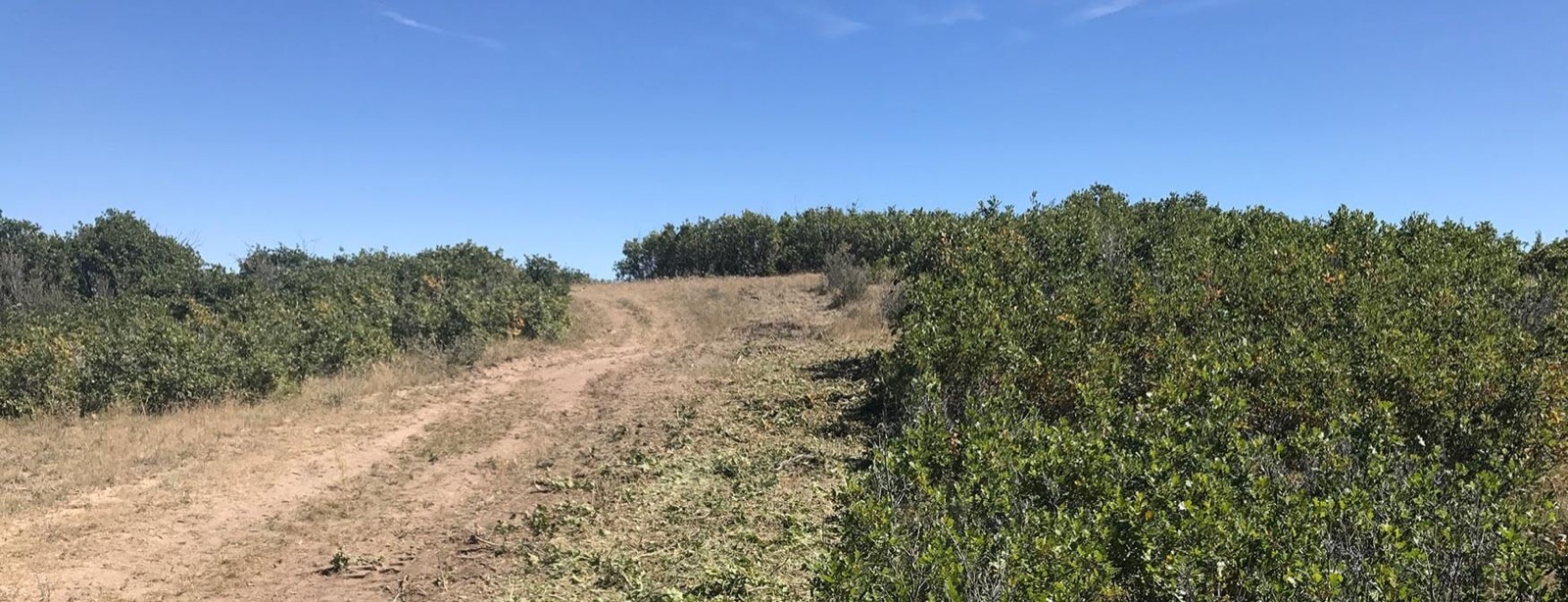
Where the Streets End and the Oak Starts
Colorado Springs has a hard western edge. Pavement stops, foothills start, and the transition zone between them is stuffed with Gambel oak. Cedar Heights sits inside it. Mountain Shadows backs onto it. Peregrine's upper streets wind through it. These are city addresses with wildland exposure, and the oak on and around those lots is the fuel that connects open mountainside to siding and soffits. That connection is the thing I get hired to break.
Oak brush on the westside grows on slopes that faced the afternoon sun for ten thousand years and learned to love drought. It's dense, it's continuous, and it runs downhill from public land straight into private backyards. You can't mitigate the mountain. But the last hundred and fifty feet before your house belongs to you, and that's where mitigation actually works.
The exposure reaches deeper into the grid than people assume, since embers travel well ahead of any flame front. Still, the practical work concentrates where structures and oak actually touch, and on the westside that's a well-defined seam: the last row of homes against the open slopes, the ravine lots, the cul-de-sacs that finger up into the foothills. If your back fence looks at brush instead of at another fence, you're living in the seam I'm describing.
2012
What Waldo Canyon Made Obvious
In June 2012 the Waldo Canyon Fire came over the ridge into Mountain Shadows and took nearly three hundred and fifty homes in an evening. It remains one of the most destructive fires in state history, and it happened inside city limits, on streets with hydrants and sidewalks. The homes that survived that night weren't lucky in some vague way. Post-fire studies kept pointing at the same factors: fuel near structures, or the absence of it.
The neighborhoods rebuilt, and rebuilt smarter. But brush regrows and memories fade, and thirteen years is long enough for both. If you're on the westside and the oak has crept back to your fence line, you already know what the assignment is. I just bring the machine that makes it a one-day job instead of a summer of weekends.
I'd rather talk prevention than history with clients, but the history is the reason the prevention pencils. Mitigation done ahead of a fire gets measured in machine hours and mulch. The alternative got measured in city blocks. Every westside homeowner gets to pick which side of that comparison to spend money on, and the first option costs a rounding error of the second.
TERRAIN
Steep Lots, Tight Access, Tracked Equipment
Westside lots are vertical. Backyards drop into ravines, side yards are staircases, and the oak that needs grinding is often on a pitch you wouldn't push a mower across. This is where a purpose-built tracked mulcher earns its cost. Low center of gravity, wide tracks, and a head that reaches brush on grades a wheeled machine can't hold. I've spent years reading slopes for a living, and I know the difference between a hill that's workable and one that isn't.
Where the machine can't safely go, there's still a path: I hand-cut the steepest pockets and feed the material to the mulcher on more forgiving ground. Nothing gets stacked, nothing gets hauled down your street, and nothing waits around as a slash pile through a red flag summer. The material ends the day as mulch, spread where it fell.
The chips do double duty on these slopes. Westside soils are decomposed granite that erodes the moment it loses cover, and a mulch blanket holds that ground through the summer storm season while grass reestablishes underneath. You get fuel reduction and slope stabilization from the same pass, which is a better deal than either one bought separately.
NEIGHBORHOODS
Cedar Heights to Peregrine, Lot by Lot
Gated communities like Cedar Heights have their own mitigation cultures, and I fit into them easily: quiet single-operator work, documented scope, no convoy of trucks. In Mountain Shadows and Peregrine, most jobs are backyard and slope-edge clearing, often coordinated between two or three adjacent owners who share a ravine. Splitting one mobilization across neighbors drops everyone's price, and treating a shared slope as one piece of ground is better mitigation anyway. Fire doesn't read property lines.
The city and the fire department have pushed wildfire education here harder than anywhere in the state, so most owners I meet already know what needs to happen. My job is making it happen without wrecking the hillside, the view, or the month's budget.
Slope aspect deserves a mention in these neighborhoods too. Oak on south and west facing ground dries out weeks ahead of everything else and stays dry deeper into fall, which is why those slopes get mitigation priority even when the north-facing brush looks thicker. Aspect is one of the first things I read on a westside walk-through, and it often reorders which sections of a property see the machine first.
NEXT MOVE
Lining Up Westside Oak Work
I come down from Larkspur regularly for Springs work, and I batch westside jobs to keep travel cost off your invoice. The estimate is a walk-through, not a phone guess, because slope and access drive the price up here more than raw acreage does. I take cash and checks, and the number I give you is the number you pay.
Book through the free quote page or call (719) 400-9104. For the bigger picture on protecting Springs properties, my fire mitigation Colorado Springs page covers the full scope beyond oak, and it's worth five minutes before we walk your lot.
Free Quote · No Obligation
Clear the fuel before fire season, not during it
Or call the shop: (719) 400-9104