
Scrub Oak Removal in Black Forest
Black Forest already had its fire, and the forest that's growing back deserves better than a new understory of Gambel oak wiring the fuels back together. I masticate oak off recovering ground along Shoup Rd, Burgess Rd, and the gravel grid between them. The point is keeping the new forest open enough that 2013 stays history.
SINCE THE FIRE
Thirteen Years After the Smoke Cleared
The Black Forest Fire of 2013 took over five hundred homes and burned through fourteen thousand acres of ponderosa. This community doesn't need a lecture about fuels from me or anyone else. You lived it, or you bought in knowing it. What's worth talking about is what the land has done since. The burn scar is filling back in, replanted pines are chest high in places, grass came back strong, and mixed into all that recovery is a plant the fire barely inconvenienced: Gambel oak.
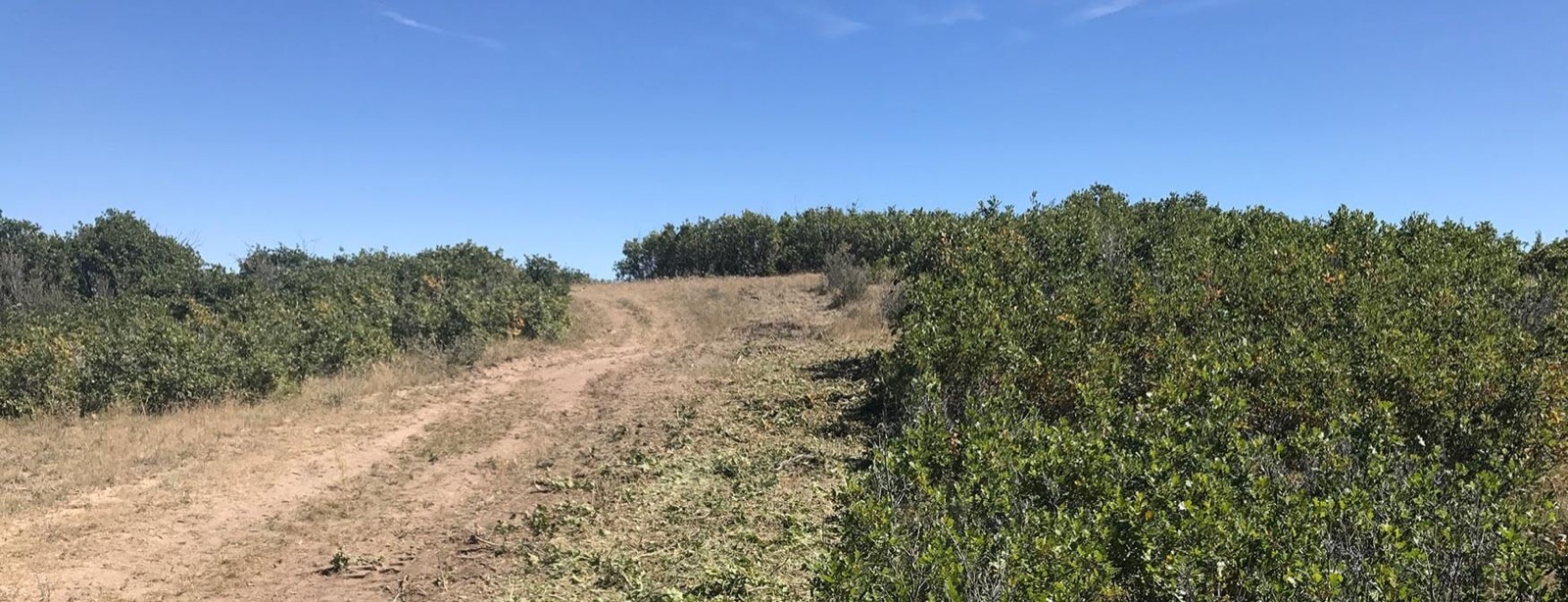
Oak survives fire underground. Its lignotubers sit below the heat, and after a burn it resprouts faster than nearly anything else on the site. So parts of the scar that were open pine forest before 2013 are now oak brush with young trees poking through it. Left alone, that's next cycle's fuel bed assembling itself in plain sight.
Nobody out here treats mitigation as an abstraction anymore. And that changes the work. The oak conversations I have along these roads are the most clear-eyed on my schedule, because this community carries real before-and-after knowledge of what fuel does when the weather lines up wrong. My end of the deal is matching that seriousness with a capable machine and a straight written scope.
SCAR GROUND
Oak Filling the Openings the Burn Left
Fire opened the canopy, and open canopy is exactly what oak wants. On lots off Burgess Rd and the north end of the scar, I'm seeing oak clones spread wider than their pre-fire footprint, dense at the base and gaining a foot or more a year. The dangerous part isn't the oak itself. It's what it touches: young planted pines with branches still at ground level, standing dead timber that never got felled, and the homes people rebuilt with insurance money and stubbornness.
Mastication resets those clones to mulch without disturbing recovering soil, which matters on ground that's already been through erosion cycles after the burn. The machine grinds oak around your replanted seedlings, and I work carefully enough that the trees you've been babying for a decade come through untouched. Those seedlings are the whole future of this forest. I treat them that way.
Timing matters with scar-ground oak more than people expect. Young clones are cheap to grind and slow to recover. The same clone left another five years develops thicker stems, deeper reserves, and a faster resprout, so the price of waiting compounds twice, once in machine hours and once in regrowth vigor. If your oak is still under head height, you're inside the cheap window right now. It doesn't reopen.
THE GOAL
An Open Forest Is the Whole Point
Old-timers here remember what Black Forest looked like before a century of fire suppression let it thicken: big pines, wide spacing, grass underneath. Fire moved through that structure low and slow and mostly did the forest good. That's the structure worth rebuilding, and controlling oak is a core piece of it. Not eliminating oak. Nobody eliminates Gambel oak, and its clumps feed deer and hold snowmelt on land that needs every inch of water. Controlling it. Keeping it in scattered islands instead of a connected understory.
On a typical lot that means grinding the oak nearest structures and driveways to bare mulch, thinning the middle ground into separated clumps, and leaving back-corner thickets that threaten nothing. You keep the wildlife, the screening, and the privacy. Fire loses the connectivity it needs.
Grass is the quiet winner of this structure. Open, mulched ground under pines grows the native bunchgrasses that used to define this plateau, and a grassy understory burns cooler and slower than any shrub layer. It's also mowable, which puts routine fuel maintenance back within reach of a homeowner and a Saturday morning. The machine sets the structure. The grass keeps it honest between my visits.
LOCAL WORK
Along Shoup, Burgess, and the Gravel Grid
I work the whole Black Forest road grid, from the Shoup Rd corridor up through Hodgen and out east where lots stretch to five acres and beyond. Some jobs are quarter-acre home defense. Some are full-parcel passes on land that hasn't been touched since the fire. Access is usually easy out here, the ground is mostly forgiving, and a tracked machine can cover real acreage in a day once it's on site.
What I ask from owners is simple: know your property lines, flag anything buried or sentimental, and be reachable by phone while I'm grinding. What you get back is a lot that's walkable again, defensible again, and honestly better looking. Mulched ground under pines reads as parkland, not as a clearing project.
SCHEDULING
Getting Oak Work Done Before the Next Dry Cycle
Wet springs grow fuel and dry summers test it. The years since the fire have swung between both, and every wet cycle adds height to the oak. There's no bad season for mastication. I grind in snow, in mud that would bog a truck, and through winters when burn piles sit waiting on permit weather. That's the quiet advantage of mulching: no pile, no permit, no smoke column making your neighbors nervous.
I'm based up the road in Larkspur and I'm in Black Forest constantly. Ask for a walk-through on the quote page, and if your project is bigger than oak, my brush clearing service covers the deadfall and regen side of the same problem. Cash and checks, one operator, firm numbers.
Free Quote · No Obligation
Clear the fuel before fire season, not during it
Or call the shop: (719) 400-9104