
Gambel Oak Management in Larkspur
You don't defeat Gambel oak in Larkspur. You come to terms with it. The clones under Spruce Mountain and along the Greenland Open Space edges were here first and they'll be here after us, so the real skill is a management rhythm that keeps them low, spaced, and working for the property instead of against it. That rhythm is what I sell.
PERSPECTIVE
The Plant That Outlasts Every Owner
Some of the Gambel oak clones around Larkspur are old in a way that's hard to hold in your head. A single clone spreads underground for decades, sometimes centuries, sending up stems, losing them to fire or frost or a rancher's blade, and sending up more. The thicket behind your house isn't a bunch of shrubs. It's one organism with deep reserves and infinite patience. Every deed transfer in this valley has happened on top of oak roots that didn't notice.
Once you see it that way, the management question changes shape. You stop asking how to get rid of it and start asking what relationship you want with it. Fuel load you control, screening you keep, browse for the deer that walk through every evening. All of that is available. It just isn't available for free or forever from one weekend of cutting.
Fire history is written into these clones as well. Gambel oak evolved alongside burning, and every historic fire that crossed this valley pruned the stems and provoked the roots. That's why oak is the first thing back after any disturbance, and why it treats a mastication pass like a familiar event rather than a defeat. Understanding that takes the frustration out of regrowth. The plant is doing the only thing it has ever done. The management plan just has to be as patient as the plant.
REGROWTH
Year One Through Year Five After a Grind
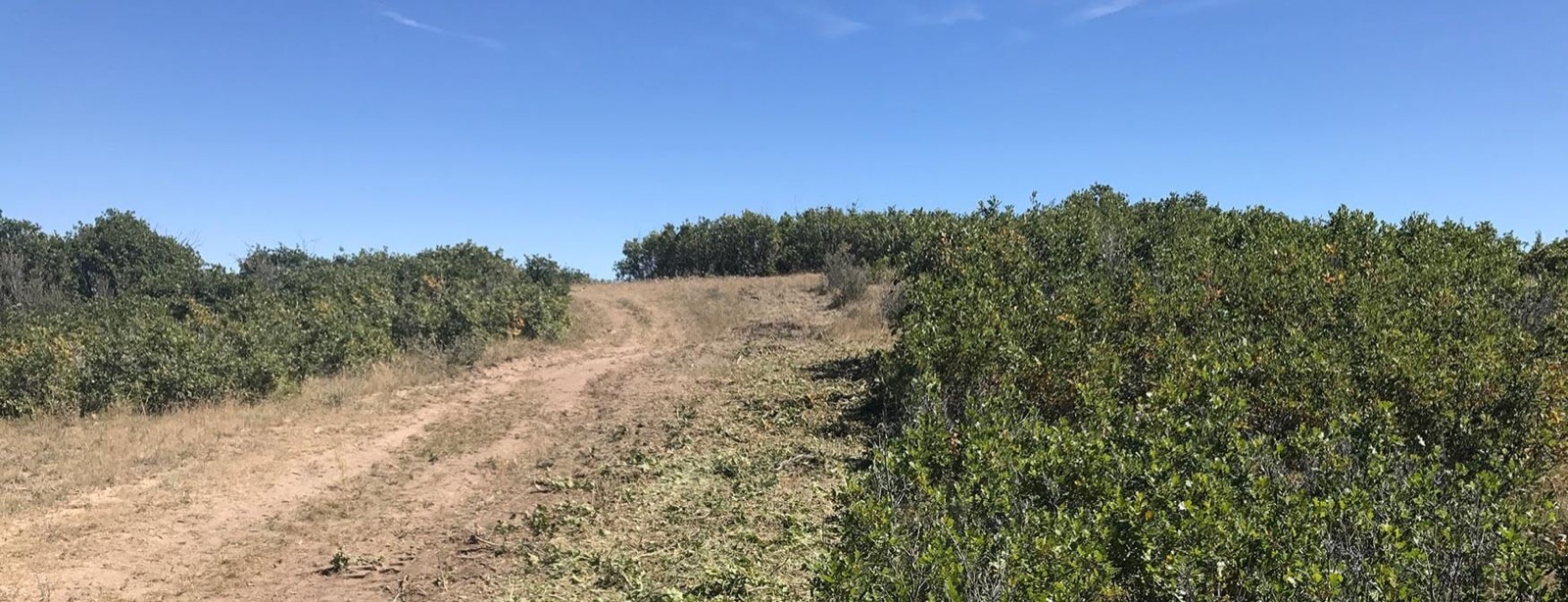
Owners deserve to know exactly what happens after mastication, so here's the honest timeline on Larkspur ground. The first summer, sprouts push up through the mulch, knee-high, dense, almost cute. Second season they're waist-high and woody at the base. By year three you've got a thigh-to-chest-high shrubland that's still easy to walk and still nearly harmless as fuel. Years four and five is when it starts becoming a thicket again, head-high in the moist draws, and the window for cheap maintenance starts closing.
So the management interval writes itself: touch the regrowth somewhere in years two through four. A maintenance pass at that stage runs a fraction of the original clearing, because the machine is grinding pencils instead of wrists. Let it go eight or ten years and you're paying first-pass prices all over again. The oak doesn't punish you for managing it. It punishes you for pausing.
Moisture swings move that timeline around, too. A wet stretch like this valley sometimes gets can compress the schedule by a full season, with regrowth hitting year-three height in year two. Drought stretches it out. So I don't manage by calendar alone. I manage by looking, and my rotation clients get a quick drive-by check when their zone comes due, in case the oak has voted to reschedule itself.
THE SYSTEM
Building a Rotation Instead of a Rescue
Most of my long-term Larkspur clients run their oak on a standing rotation with me. We divide the property into zones, keep the home ignition zone on the tightest cycle, and let the outer ground run longer intervals where taller regrowth threatens nothing. I keep notes on what was ground and when, and I reach out when a zone is coming due, the same way a good septic or chimney outfit would. Nothing renews automatically. You get a quote each time, you pay cash or check each time, and you can stop whenever.
What the rotation buys you is a property that never gets scary again. No wall of brush creeping toward the house, no five-figure rescue project after a decade of looking away, no scramble when an insurance carrier suddenly wants photos and a paper trail. Steady beats heroic in this business, every time.
EDGES
Living Next to Spruce Mountain and Greenland
Larkspur properties often share a line with ground nobody's going to mulch: the Spruce Mountain Open Space trails, the huge Greenland Open Space to the south, private ranch parcels running brush to the horizon. Those edges are where management thinking matters most. You can't treat the far side of the fence, so the near side has to carry the whole mitigation load: a wider ground-down band along the boundary, thinned islands stepping back toward the house, and a clean transition you can maintain with a mower between machine visits.
I like leaving some structure along those edges on purpose. A managed oak band still screens the trail traffic, still feeds wildlife moving off the open space, and still turns red-gold in the fall. It just does it at four feet instead of twelve, with gaps fire can't cross in one push.
Trails bring one more consideration: ignition sources. Ground near open space parking and heavy foot traffic carries more human ignition exposure than a back fence deep in a subdivision, from careless smoking to a hot exhaust parked over cured grass. That argues for keeping your boundary band wider and lower on the road and trailhead sides of a property, and it's exactly the kind of judgment call a walk-through settles better than any rule of thumb.
FIRST VISIT
Starting the Relationship With Your Oak
Whether your property needs its first big reset or just a rhythm for regrowth that's already coming back, the starting point is the same walk-through. I live and work here, my shop's on Frink Rd, and half my Larkspur clients are on some version of this rotation already. Ask for a visit on the free quote page, and if the oak conversation turns into a bigger one about the pines and the whole homesite, my forest thinning page covers that side of the work.
Free Quote · No Obligation
Clear the fuel before fire season, not during it
Or call the shop: (719) 400-9104