
Defensible Space in Fremont County. Fire Mitigation
Fremont County fire risk doesn't look like the postcard version of Colorado wildfire. It's grass, pinyon, and juniper on dry ground, and it burns low, fast, and early in the season. I build defensible space by grinding that fuel into mulch on site with a tracked machine.
LOW COUNTRY
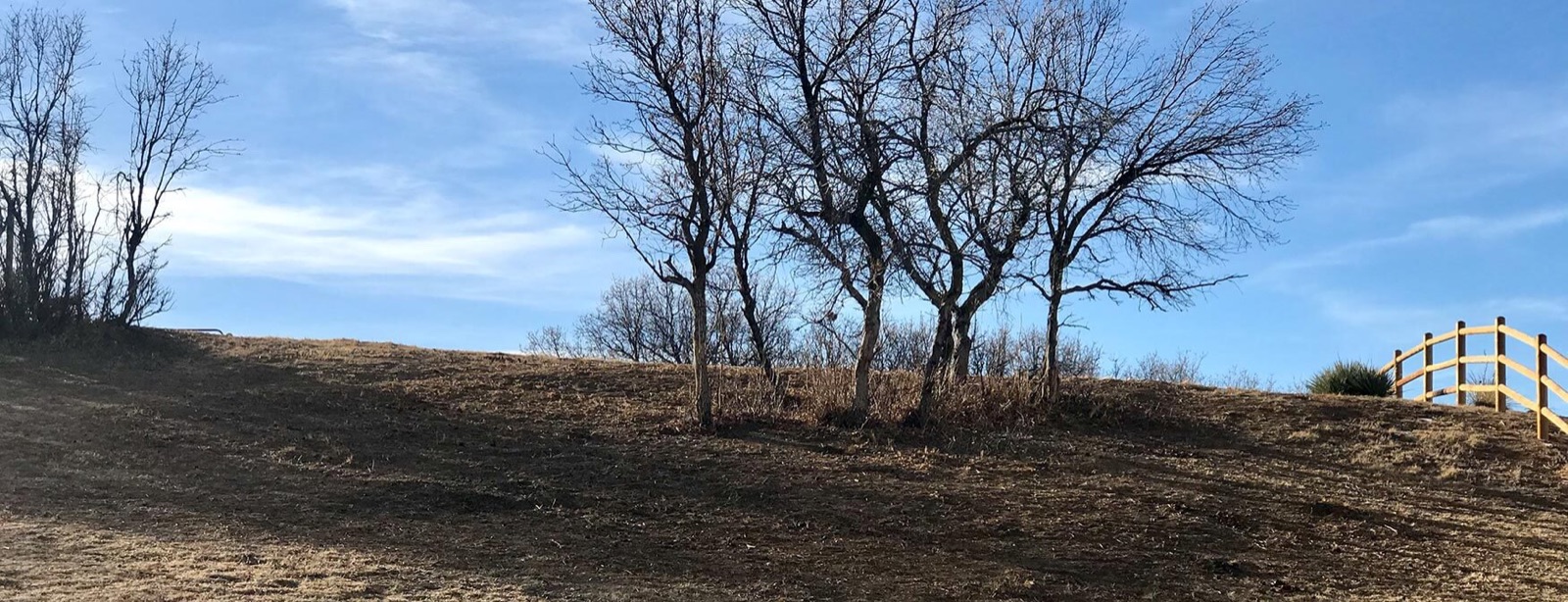
Grass and PJ Burn Faster Than People Expect
Most of Fremont County sits lower and drier than the counties around it. From Penrose across to Canon City and up into Copper Gulch, the fuel is cured grass running between pinyon and juniper, with cholla and rabbitbrush mixed in. Timber fires get the news coverage, but grass fires are what put homes at risk here most years, because grass ignites at the drop of a chain spark and carries flame at a walking-pace-beating speed on any wind. The junipers scattered through it act like fuses. Fire runs the grass, hits a juniper, and suddenly you've got sixty-foot flame lengths and embers flying.
And the season is long. This country can burn in February. Down here, mitigation isn't a summer project. It's a year-round property condition.
The 2013 fire above the Royal Gorge made the point at county scale. It ran through gorge-country PJ in June, crossed the canyon, and took most of the park's structures before crews could get ahead of it. Same fuels, same terrain, same wind that runs the whole county. What burned there is what's growing on a few thousand private parcels right now.
THE MAP
BLM Checkerboard, Private Ground, and Whose Problem the Fuel Is
A lot of Fremont County property borders federal land in the old checkerboard pattern, especially out toward Phantom Canyon and Copper Gulch. That matters for two reasons. First, the fuel on the other side of your fence line may never get treated, so your own defensible space has to carry the full load. Second, you need to know exactly where your line is before any machine works, because clearing an acre of BLM by accident is a serious problem. I check parcel boundaries before I quote and again before I cut.
The practical takeaway: if your lot backs onto public land, plan your mitigation assuming a fire arrives from that side with nothing slowing it down. Depth matters more than tidiness. A thin decorative buffer does little. A wide band of ground fuel taken down to mulch does a lot.
Prisons, quarries, and rail lines thread through this county too, and they've all started fires along their edges over the years. Ignition sources here are constant and mostly human: chains dragging on pavement, hot exhaust in tall grass, target shooting on a dry afternoon. You can't control the spark. You can control what it lands in, out to the edge of your deed.
THE WORK
Building Defensible Space on Dry, Fragile Soils
The mistake I see on dry ground is blading it bare. Scraped earth here doesn't grow back for years. It blows, it gullies in the summer monsoons, and it looks terrible. Mastication solves the same fuel problem without creating a dirt problem. The tracked Rayco grinds juniper, brush, and doghair pinyon into a mulch mat that stays on the surface, shades the soil, and knocks down dust. Fire hitting a mulch bed creeps and smolders instead of running. Fire hitting standing juniper explodes. That's the trade in one sentence.
Around the house I cut aggressively. Out past that, I thin: healthy pinyon stays on wide spacing, junipers near structures and under other trees go, and the grass gets broken up by the mulched strips so it can't carry flame in an unbroken sheet.
Cactus and yucca country asks for a lighter touch than timber, and the machine can deliver it. Head height, travel speed, and route all adjust to what the ground shows me. On thin-soil parcels I'll leave more standing cover on purpose, because shade is what keeps the grass from flashing back thicker the next spring. Mitigation that ignores the regrowth cycle is mitigation you'll pay for twice.
GROUND TRUTH
Penrose Flats to Phantom Canyon Grades
The county's variety shows up in the work. Penrose and the Highway 50 corridor are mostly flat, fast machine ground where acreage moves quickly and pricing stays friendly. Coal Creek and the hills south of the river bring slope into it. And the canyon country, Phantom Canyon and Copper Gulch, adds narrow access roads and rock, which slows everything down and raises the price honestly. Tracks handle all of it, but I'll tell you up front which category your lot falls into, because that's most of what your estimate is.
Water access shapes outcomes down here too. Much of rural Fremont County runs on wells and haul water, with hydrants only in town. Engine crews defending your place will work off tank water and whatever cistern or pond they can reach. Give them room: cleared ground around structures and a driveway that fits an engine. Those two things cost little and change everything about how defensible your property reads.
NUMBERS
What Goes Into a Fremont County Estimate
I quote after walking the ground, not from satellite photos, because juniper density and hidden rock don't show from space. The estimate covers the full job: mobilization from Larkspur, the machine work, and a finished lot with the material mulched in place. No haul-off line item, no burn pile babysitting, no surprise second invoice. Payment is cash or check when you've walked the finished work.
Small county, honest word travels. Ask around Penrose or Canon City and you'll find people who've watched this machine work. I'd rather earn the next job from the last one than from an ad.
Fremont County is regular territory for me. Start at the quote page, or look over the brush clearing service to see how I handle exactly this fuel type. If you'd rather talk first, call (719) 400-9104 and I'll answer, because there's nobody else here to answer it.
Free Quote · No Obligation
Clear the fuel before fire season, not during it
Or call the shop: (719) 400-9104