Firewise Landscaping and Fire Mitigation in Boulder
Firewise landscaping isn't a plant list, it's an arrangement: what grows where, how close, and what connects to what. Boulder's fire history, from Fourmile Canyon to the Marshall Fire, is a course in fuel arrangement. Here's how we apply it with a mulcher.
FIREWISE
Landscaping That Won't Carry Flame
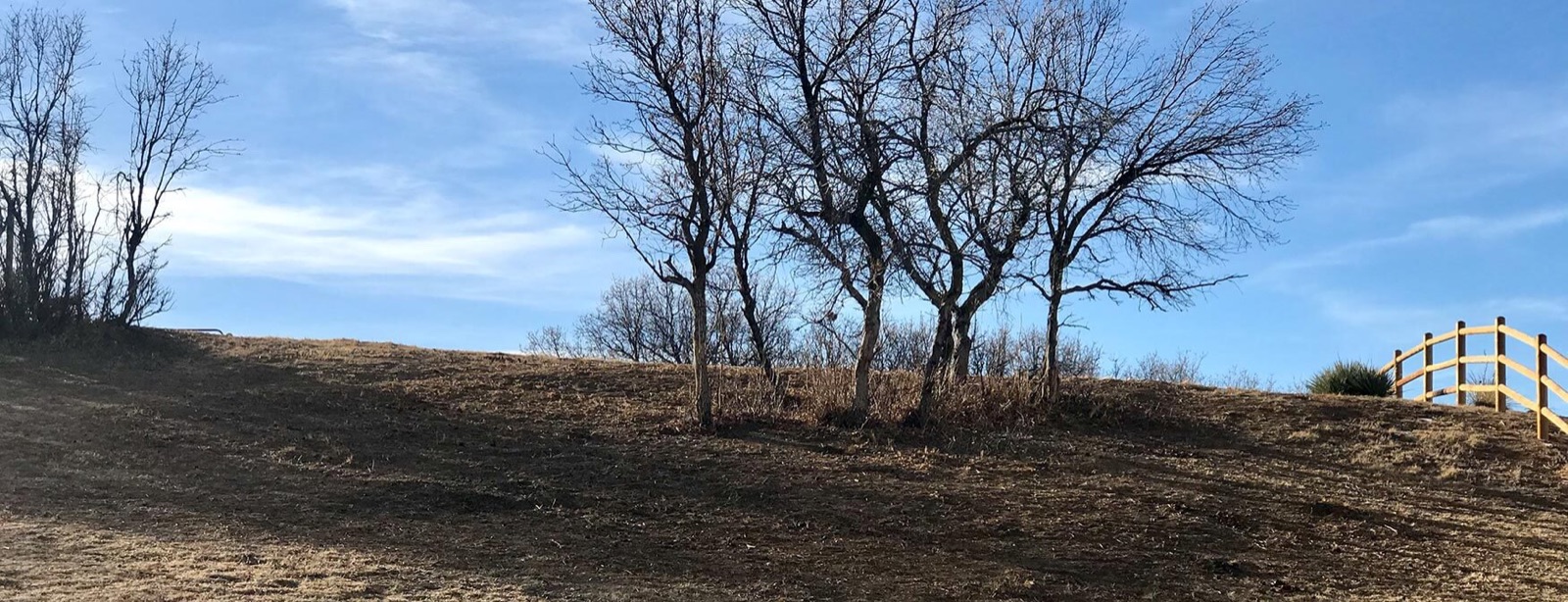
Firewise landscaping gets reduced to shopping lists of fire-resistant plants, and that misses the point. Arrangement beats species. A fire-resistant shrub planted in a continuous bed against your siding is still a wick. A flammable native tree standing alone in mowed grass, forty feet from the house, is nearly harmless. The principles are spacing, separation, and interruption: no continuous vegetation path from wildland to wall, no ladder from ground to canopy, nothing burnable in the first five feet of the structure. On Boulder's mountain and interface properties, applying those principles means moving serious volume of brush and small trees, and that's machine work before it's ever garden work.
The five-foot zone is worth stating plainly, since it decides most ember ignitions: rock or bare ground against the foundation, no wood mulch touching siding, nothing stored under the deck. That part is homeowner work, cheap and immediate. Everything past it scales up fast, and that's where we come in. And if Boulder's open space culture makes fuel work feel anti-nature, consider that these ponderosa foothills evolved with frequent low fires. Thinning approximates what fire used to do here before suppression.
FIRE HISTORY
Two Fires, Two Different Lessons
Boulder County has been schooled twice in fifteen years, by two completely different fires. Fourmile Canyon in 2010 was the classic mountain scenario: steep timbered canyons west of town, wind-driven fire through unmitigated forest fuel, 169 homes gone in the foothills. The Marshall Fire in December 2021 was the opposite: a grass fire on the open plains, driven by hundred-mile-an-hour downslope winds, that entered suburbia and destroyed over a thousand homes without any forest involved at all. Together they bracket Boulder's whole risk picture. The mountain properties need forest fuel work. The interface neighborhoods need grass and brush management right up to their fences. Both lessons point at the same principle: it's the continuity of fuel, not the type, that carries disaster.
Neither fire waited for a hot month, either. Fourmile started in September, Marshall in late December. Boulder's fire season is now a calendar-free concept, which means fuel has to be managed as a standing condition, not a summer chore.
THE TERRAIN
From Table Mesa to Pine Brook Hills
Boulder's fuel wraps around the city. To the southwest, Table Mesa and the Chautauqua edge run straight into open space grassland and ponderosa slopes, with homes sitting yards from city-managed fuel. West and north, Sunshine Canyon and Pine Brook Hills climb into the timbered foothills that Fourmile burned, where lots hold dense conifer on steep ground and the roads out are narrow. Each setting gets a different treatment. On the mountain lots, we grind understory and ladder fuel between keeper trees, opening the stand so fire stays on the ground. On the interface edges, we cut the brush and volunteer growth in the private strip between open space and structures, turning it into a maintained gap. The tracked machine handles the canyon grades that make hand crews slow and hauling absurd.
Access shapes the mountain work. Pine Brook Hills and Sunshine Canyon driveways run steep, narrow, and often shared, so we plan staging carefully, and the compact tracked machine earns its footprint. Where a chip truck can't go, the mulcher simply walks.
MULCH
Turning Brush Into Groundcover Instead of Flame
Every branch we grind stays on the property as mulch, and on Boulder ground that's a feature three times over. First, fire behavior: a compact mulch mat carries flame poorly compared to standing brush, and it eliminates the slash piles that sit as concentrated fuel while owners wait for a burn window that Boulder County may never grant. Second, erosion: Fourmile's aftermath showed what bare burned slopes do in a thunderstorm, and mulched ground holds soil that scraped or burned ground sheds. Third, the landscape: mulched clearings green up with native grass instead of eroding into weeds. So mastication fits the firewise ethic better than cut-and-haul ever did. Nothing is trucked down Sunshine Canyon, and nothing waits to burn. Our brush clearing page walks through the method.
Depth matters, and we manage it. A couple of inches of chunky mulch behaves well in fire terms; deep piles don't, so we spread rather than heap, and we keep the mat pulled back from structures like any other groundcover.
SCOPING
Scoping Firewise Work on Boulder Ground
Boulder estimates swing more than anywhere else we work, because the terrain does. A flat interface strip behind a Table Mesa fence is a quick day. A steep, densely timbered lot off Sunshine Canyon is a multi-day job with careful machine lines. The drivers are the usual three, slope, density, access, with slope carrying the most weight in the foothills. Boulder County and local districts run some of the most active mitigation programs in the state, with chipping, assessments, and periodic cost-share, so ask what's available before you schedule anything. Then get us out for a look. We'll flag the keepers, map the treatment areas by zone, and give you one number, with the material staying on your land as groundcover.
Wildlife and view considerations get flagged in the same walk. Boulder owners tend to want habitat kept, and patch-based grinding, with islands of cover left between treated bands, delivers fuel breaks without silencing the songbirds.
Fourmile and Marshall were arrangement failures at landscape scale. Your lot is the piece of the arrangement you control. Request a mitigation quote or call (719) 400-9104 to get it working in your favor.
Free Quote · No Obligation
Clear the fuel before fire season, not during it
Or call the shop: (719) 400-9104