
Topography and Fire Mitigation in Black Forest
Black Forest is mostly gentle ground, and that fools people. The 2013 fire proved flat topography with continuous ponderosa can burn as destructively as any canyon. Mitigation here is about the fuel, because the terrain gives fire everything else it needs.
TOPOGRAPHY
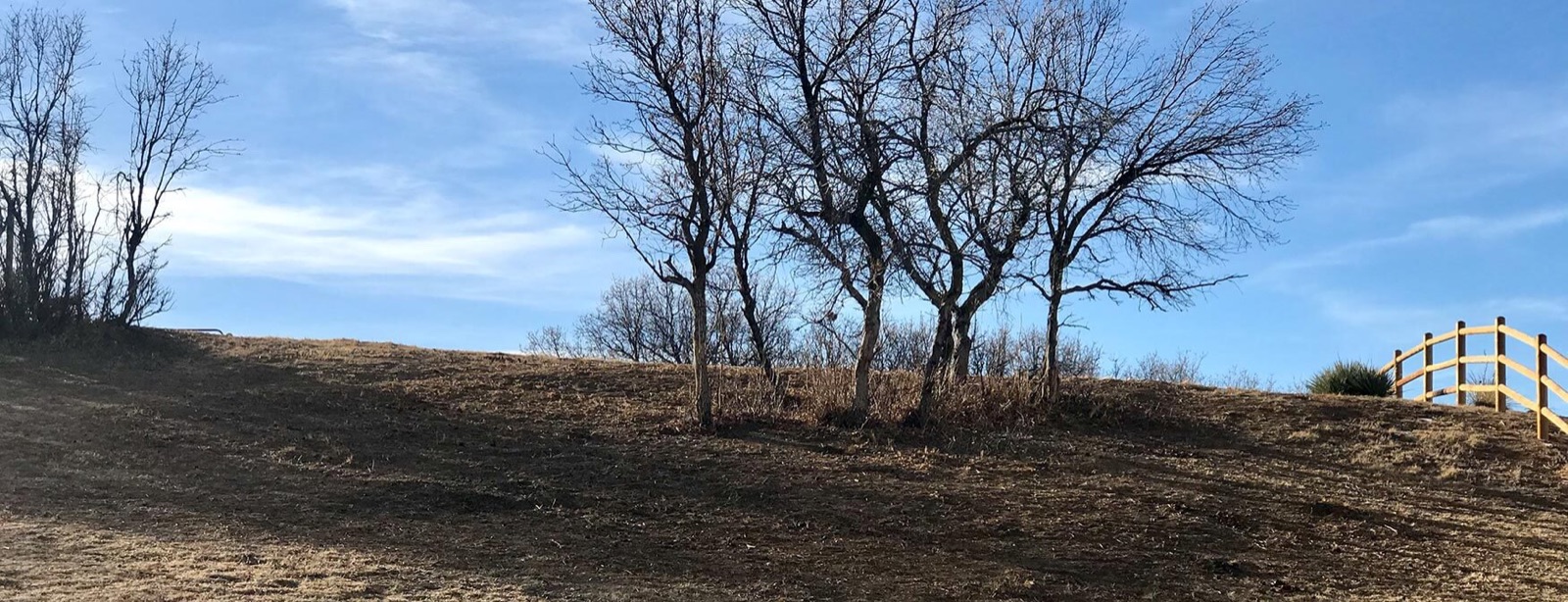
Flat Ground, Fast Fire
Fire behavior training talks constantly about slope, and for good reason: fire accelerates uphill. So people living on the rolling plateau of Black Forest sometimes assume their gentle topography protects them. It doesn't, and the reason is wind. On flat ground, wind takes over the role slope plays, and the Palmer Divide serves up hard, dry winds that push fire laterally through fuel at speeds crews can't flank. Flat terrain also means fire spreads in every direction wind allows, without ridgelines to check it. What flat ground gives you is one advantage: machines work it easily, which means mitigation is cheaper and faster here than almost anywhere in the foothills. The fuel is the whole problem. And the fuel is treatable.
The forest's structure compounds the wind issue. Black Forest ponderosa grew back dense after the logging era, denser than the historic open stands that used to survive frequent light fires. Today's stand density plus today's understory produces fire behavior the original forest never did. Wind, density, continuity. Those are the three words for this plateau.
2013
What the Black Forest Fire Made Plain
There's no need to speak in hypotheticals here. In June 2013 the Black Forest Fire burned roughly 14,000 acres of this forest and destroyed about 489 homes, the most homes Colorado had ever lost to a single fire at the time. Two people died. It moved through exactly the terrain you live on: flat to rolling ponderosa with dense understory, houses threaded through the trees along Black Forest Road, Shoup Road, and Burgess Road. The lesson wasn't subtle. Continuous canopy plus heavy understory plus wind equals a fire that takes whole streets. But the after-action surveys also showed the other side: homes with real defensible space and thinned stands survived at far higher rates. The difference wasn't luck. It was fuel.
If you lived here then, none of this is news. If you bought in afterward, drive Shoup Road and read the landscape: the scar line, the young regrowth, the stands that made it. The whole mitigation argument is written on the ground within five miles of your house.
REGROWTH
A Decade of Regrowth Along Shoup and Burgess
More than a decade on, the forest is filling back in. Burn-scar ground is coming up in oak, wax currant, and thick pine regeneration. Unburned stands have added ten-plus years of understory since the fire concentrated everyone's attention. And new construction has pushed more homes into the trees. We grind a lot of ground in this area, and the pattern is consistent: properties mitigated after 2013 that need a maintenance pass, and properties untouched since before the fire that need the full first treatment. Both are straightforward on this terrain. The tracked mulcher grinds oak regrowth, doghair pine thickets, and ladder fuel in place, and the flat ground lets us cover acreage quickly. Our forest thinning page shows what treated ponderosa stands look like when the machine is done.
Regrown oak deserves particular attention. The post-fire scrub is now tall enough to work as ladder fuel again, and it's coming up under young pine that's more vulnerable to torching than mature trees ever were. Ground that burned once isn't immune. It's just earlier in the cycle.
GROUND FUEL
Needle Duff, Deadfall, and the Mulch Answer
Ponderosa forests build fuel from the top down. Needles rain onto the floor every year, branches drop, and beetle-killed or drought-stressed trees fall and stack. Untended Black Forest ground carries a deep duff and deadfall layer that lets fire persist, creep, and reignite even after a front passes. Mastication addresses the standing portion of that equation and converts it into something better: ground brush and small trees become a compact mulch layer that holds soil moisture, breaks the vertical fuel ladder, and decomposes into the sandy Black Forest soil instead of standing there waiting for ignition. Compare that to burn piles, which this community has understandably little appetite for, or hauling, which on multi-acre lots means paying to truck away material your soil could have used.
We leave the big trees alone, for the record. Mastication targets the understory and small-diameter stems, exactly the layer the fire science says to remove first. The mature ponderosa canopy, thinned and pruned up, is what makes this forest worth living in.
GETTING AHEAD
Getting Ahead of the Next Dry June
The 2013 fire started in June, and June is always coming. The practical calendar: grind in fall through spring, when the ground is firm and the schedule is open, so your fuel is broken before the dry wind season starts. El Paso County and the local fire district have run slash and mitigation programs in various forms since the fire, so call and ask what's active this year before you schedule, and stack that help with the machine work. Pricing on Black Forest jobs is friendlier than foothills work because the terrain barely slows us down. Density sets the number: heavy doghair and mature oak cost more machine hours than open understory. Acreage helps you, since flat contiguous ground grinds efficiently. And maintenance matters here too: a lot treated in 2015 has a decade of regrowth on it now, and a regrind costs a fraction of the original job while the protection resets in full.
This community has already paid the full price of untreated fuel once. Request a mitigation quote or call (719) 400-9104, and let's make your piece of the forest the kind that survives the next one.
Free Quote · No Obligation
Clear the fuel before fire season, not during it
Or call the shop: (719) 400-9104