
Fence Line Clearing in Douglas County
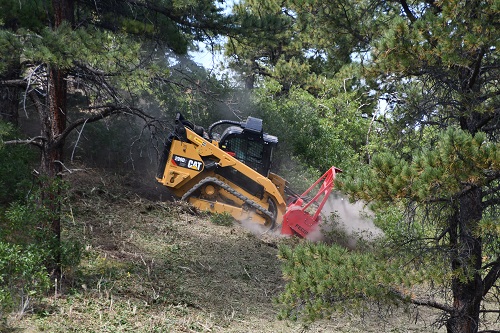
Every fence line in Douglas County is slowly being eaten. Birds perch on the wire, seed drops, and ten years later there's a hedgerow of oak and cedar swallowing your posts. We grind fence lines clean with a tracked mulcher, without pulling wire or wrecking corners.
HOW IT HAPPENS
A Fence Is a Bird Perch, and a Perch Plants Trees
It's not bad luck that brush grows exactly along your wire. Birds sit on fence wire by the hundred, and everything they've eaten gets deposited directly below: juniper berries, oak acorns cached by jays, chokecherry pits, Russian olive seed. The fence line gets watered by runoff, protected from grazing, and skipped by the mower. So it becomes the best tree nursery on the property. Give it a decade of neglect and you've got a woody hedgerow with steel somewhere inside it.
By then the damage compounds. Roots heave posts. Trunks grow around wire until it can't be re-tensioned. Snow loads the brush and lays whole sections over. And when you finally need to find the fence, you can't.
Russian olive and Siberian elm deserve special mention, because they're the fastest of the fence-line invaders and the most stubborn once established. Both shrug off casual cutting. Grinding them low and letting the chip mat smother the first resprout flush is the start of control, and scheduled return passes finish the argument.
MACHINE WORK
Grinding Parallel to the Wire Without Pulling a Post
The way we clear a line matters as much as clearing it. The mulcher works parallel to the fence, running a clean swath down one or both sides, taking brush and volunteer trees down to ground level and grinding them to chips in the same pass. The head is precise enough to work close to the wire without snagging it, and stems growing tight against posts get dropped by hand so nothing torques the fence. You keep your posts, your wire, your tension. You lose the hedgerow.
Trunks that have fully grown around wire are the one honest exception. We'll cut them off at the height that saves the fence, and flag them so you know where the wire needs a splice.
Wire health gets a look as we go. We'll flag broken strands, leaning posts, and tension problems the brush was hiding, so your fence contractor, or your Saturday, knows exactly where to start.
DETAILS
Gates, Corners, and Knowing Where the Line Really Is
Corners and gates are where fence lines earn their maintenance. Corner posts carry the tension of the whole run, and brush levering against a corner assembly will slowly pull a fence out of square. Gate areas collect traffic, weeds, and volunteer trees right where you need clearance to swing and to see. We clean these zones wider than the run itself, and we finish them by hand where the bracing is tight.
One caution from experience: old fences and true property lines aren't always the same thing. If the boundary matters, especially before clearing a disputed or long-lost line, locate your survey pins first or get the parcel surveyed. We're happy to clear to the pins once you know where they are. We're not the ones who get to decide where your property ends, and we don't grind on a neighbor's side of an uncertain line.
FIRE VALUE
A Clean Line Doubles as a Fuel Break
Here's the bonus most owners don't order but all of them get. A cleared fence corridor is a linear gap in the fuel, often the only one on the parcel. Grass fire hits the masticated strip and loses intensity. Crews get a natural anchor line for backburns or a route for a brush truck along the perimeter. In open ranch country, where fires move with the wind across property after property, those perimeter breaks are worth real money the day one shows up. The same logic drives our wider brush clearing work.
A brushy fence line does the opposite: it's a wick, carrying flame along the exact corridor that connects your neighbor's fire to your pasture.
PRICING
What Moves the Number on a Line Job
Fence line clearing prices on a few honest variables. Density and age of the growth lead the list: ten-year oak grinds fast, thirty-year cedar with six-inch trunks takes real time. One side or both sides roughly doubles the swath. Access matters, since a line the machine can walk beside costs less than one on a steep ditch bank or behind locked gates on a neighbor's side. And total distance helps you, because setup costs spread across every additional quarter mile.
We quote after seeing the line, either walking it or, on long runs, driving it together. You'll get a number for the whole job, not an open-ended hourly guess, and the option to phase it: worst sections first, the rest next season. Ranch budgets work that way and so do we.
The seed rain never stops, so a cleared line is a maintained line or a temporary one. The good news is the economics run steeply in your favor. The first clearing is the expensive one, cutting decade-old woody growth. After that, the chip mulch suppresses much of the regrowth, and a fast touch-up pass every two or three years holds the corridor at a fraction of the original cost. Many of our ranch clients just put us on a cycle: we show up in the slow season, run the lines, and leave an invoice you can pay by cash or check.
Fence contractors also love following our work. New wire goes in faster and truer on ground that's been ground clean. If you're pricing a rebuild, clear first and the fence bid usually drops. Get a per-mile or per-parcel number through the quote page. We're based in Larkspur and run fence lines all over Douglas County and beyond.
Free Quote · No Obligation
Clear the fuel before fire season, not during it
Or call the shop: (719) 400-9104