
How Houses Catch Fire. Defensible Space
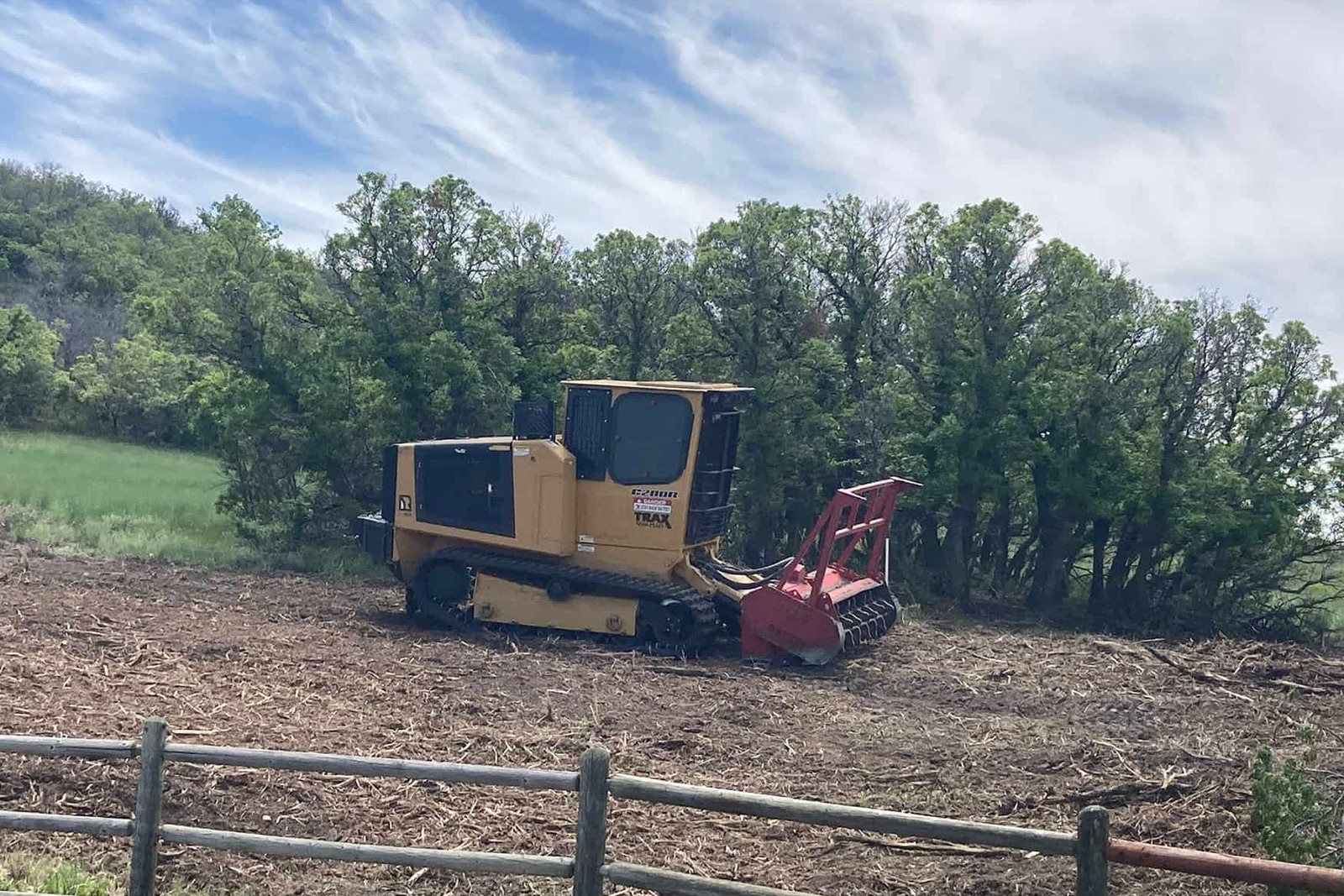
Houses don't burn because the forest arrived at the door. They ignite in one of three specific ways, and each one can be defended against. Out in Sedalia's ranch and canyon country, we build that defense with a mulcher, around the house, the barn, and the hay.
IGNITION
The Three Ways Flame Gets to a Structure
Strip away the drama and structure ignition comes down to three mechanisms. Embers, the far-reaching one: burning material lofted by wind, landing in gutters, vents, woodpiles, and shrubs up to a mile ahead of the fire. Radiant heat, the mid-range one: enough thermal load from nearby burning fuel to break windows and blister walls without contact. And direct flame, the closer's move: fire physically touching the building because fuel led it there.
Defensible space answers all three at once. Distance defeats radiant heat. Clean ground near the walls starves direct flame. And a treated landscape gives arriving embers nothing to grow up in. That's the whole theory. The rest is cutting.
TERRAIN
Between the Hogback and the Rampart Range
Sedalia country runs from the Plum Creek valley floor up through oak benches into the timbered slopes along Rampart Range Road, with Jackson Creek's drainages cutting through the middle. It's beautiful, complicated fire ground. Valley grass carries fast fire to the base of the benches. The oak takes over and adds intensity. And the canyon-and-ridge topography west of Highway 67 aligns wind with slope, which is the combination that turns a manageable fire into a running one.
Properties out here need their clearances mapped to that terrain. A house on a bench above Jackson Creek needs serious downslope work, because that's where its fire is coming from. A valley place near Plum Creek needs wide grass buffers and hardened fence lines more than it needs tree thinning.
Long-time residents out here tend to keep a mental fire map of their own, built from years of watching smoke columns on the Rampart. Trust that instinct. If a particular draw or ridge has always worried you, it's probably the right place to spend the first hour of machine time.
OUTBUILDINGS
The Barn Is a Structure Too, and So Is the Haystack
Ranch properties lose more than houses in a fire. Barns, shops, loafing sheds, and stored hay burn first and hottest, partly because nobody gives them defensible space. Hay deserves special respect: it takes an ember like a sponge takes water, it can smolder unseen for hours, and a burning hay building throws off enough heat to light everything around it. If your hay sits against the barn and the barn sits near the house, one ember is three fires.
So we treat working properties as a set of structures, each with its own cleared ring, and we look hard at the spacing between them. Sometimes the best fire advice on a ranch is where to move the haystack. We'll say so, even though moving hay isn't something we bill for.
Propane deserves its own sentence. Tanks want a wide circle of bare or mowed ground, clear of oak and tall grass, with brush kept from creeping back toward the valve end. A tank venting in a fire turns one problem into several.
FIREBREAKS
Cuts That Follow the Land Instead of Fighting It
On larger Sedalia parcels we build masticated breaks: bands of ground fuel where continuous oak and brush get knocked down to chips, placed where they'll do the most good. Along the downhill property edge. Flanking the driveway so it stays drivable in smoke. Across a draw where fire would otherwise funnel toward the buildings. A good break doesn't stop a fire by itself. It slows the spread, drops flame lengths, and gives a crew a place to make a stand, which is what changes outcomes.
The mulcher builds these fast, follows contours a blade can't, and leaves chip cover instead of a bladed scar, so the break holds soil instead of growing thistle. Larger examples are on our projects page.
Sedalia's road network is thin, and fire planning here has to respect that. Rampart Range Road is a long, exposed ridge run. Highway 67 threads a canyon. The gravel roads between them wander, dead-end, and share single bridges. On a bad day, some of those routes will be closed by the fire itself, so every household out here should know its second way out and keep its own lane drivable: brush cut well back, limbs high enough for a horse trailer, and a turnaround that doesn't require backing half a mile.
Livestock complicates evacuation more than anything else. Trailering horses takes time a running grass fire doesn't give, so a cleared, well-fenced pasture or pen positioned away from the heavy fuels is worth building deliberately: a place animals can survive a burnover if the trailers never come. We've masticated exactly these staging areas for several properties, usually as an add-on to the main defensible space work.
None of this is pleasant to think about. All of it is cheap to prepare and impossible to improvise at 2 a.m. with the ridge glowing.
LOCAL
We Live One Canyon Over
Colorado Mastication operates out of Larkspur, a few minutes down 105 from Sedalia, so this is home-ground work: no mobilization games, no waiting for a contractor to route you into a distant schedule. We know which roads wash out in May and which benches hold snow into April, and we plan cutting windows around it.
Walkthroughs are free and honest. If a pasture just needs mowing, we'll tell you to mow it. For the rest, you'll get a written price for machine work that actually changes how a fire behaves on your land. Book through the mitigation quote page, or call (719) 400-9104. We take cash and checks, and we shut your gates.
Free Quote · No Obligation
Clear the fuel before fire season, not during it
Or call the shop: (719) 400-9104