
Defensible Space in Monument Fire Adapted Community
Monument sits at 7,000 feet in the middle of the largest unbroken ponderosa stand on the Palmer Divide, which means your fire risk is shared with every lot that touches yours. We thin crowns, grind ladder fuel, and help neighbors turn adjoining properties into one continuous defensible zone.
THE STAND
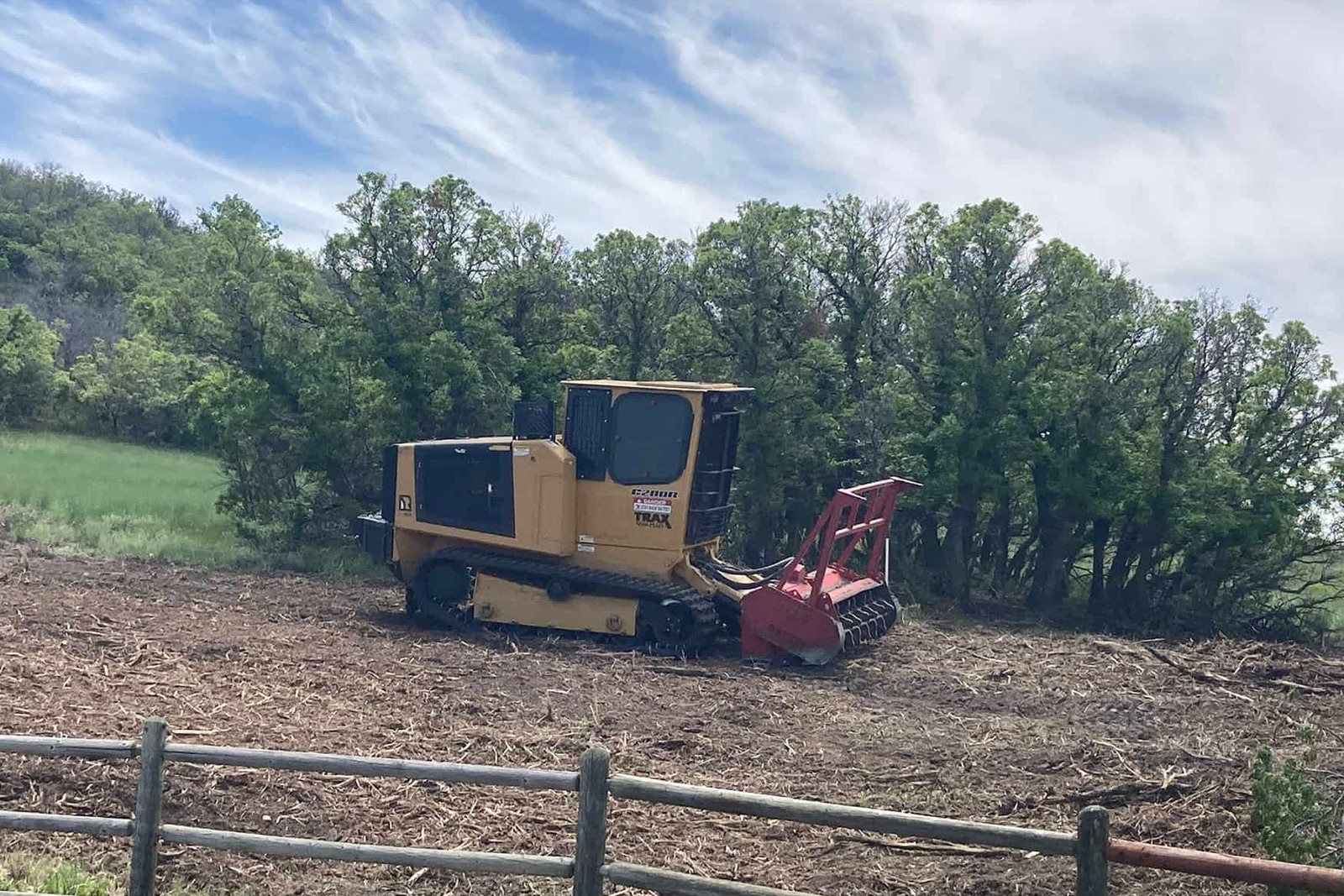
One Forest With a Few Thousand Addresses In It
The Palmer Divide catches weather from both directions, grows ponderosa thick, and holds it in a band of contiguous forest running through Monument, Palmer Lake, and the wooded subdivisions east of I-25. From the air it reads as one stand. The lot lines are invisible. And fire reads the landscape the way the air photo does: as continuous fuel, crown to crown, from the national forest boundary to your back deck.
That continuity is the core fact of Monument fire risk. It's also why the 2013 fire one divide-community south should stay in local memory. Dense ponderosa on gentle terrain, no dramatic canyon required, and the burn ran house to house through fuel exactly like what's growing here.
Woodmoor's covenants preserved the trees, which preserved the beauty and the fuel load together. Mature pines stand close to homes and closer to each other, with decades of needle cast and regeneration filling the gaps. Kings Deer trades density for scale: bigger lots, more grass between the pines, but long fuel runs connecting home sites across the golf course edges and drainages. Both communities have active fire councils, and both have miles of work left.
In either neighborhood the treatment logic is identical. Break the canopy into separated groups, get the ladder fuels out from under the keepers, and make the 100 feet around each home the most open ground on the lot.
SPACING
The Ten-Foot Rule and When to Beat It
The state standard for Zone 2 asks for roughly 10 feet between the edges of tree crowns, measured branch tip to branch tip, not trunk to trunk. That distinction surprises people. Two pines whose trunks stand 20 feet apart can still be holding hands overhead. On slopes the requirement grows, because uphill fire reaches higher and leans into the canopy above it. And crown spacing only works when there's no ladder underneath, so limbing to 10 feet and grinding the oak understory travels with every thinning job we do.
Owners worry thinning will wreck the wooded feel. It doesn't. Ponderosa grew up in open, fire-maintained stands for thousands of years. Thinned lots look older, healthier, and more like the historic forest than the doghair thickets do. Our forest thinning page shows the before and after.
Height matters as much as spacing at this elevation. Divide trees grow tall, and a 70-foot ponderosa torching in your Zone 2 reaches things a 30-foot tree never could. Where big trees stand upwind of the house we widen the gaps beyond the standard, because the standard assumed average trees and this forest doesn't grow average trees.
NEIGHBORS
Your Defensible Space Ends at a Line Fire Ignores
Here's the uncomfortable math of contiguous forest: a perfectly treated two-acre lot inside an untreated square mile is still inside an untreated square mile. Clearance helps your house regardless. But the real win is when three, five, ten adjoining owners treat together and the defensible zones merge into an actual fuel break. We see it happen more in Monument than anywhere else we work, usually started by one owner walking a quote across the street.
We make coordination easy. One mobilization across multiple lots cuts everyone's price, we sequence the work so each owner approves their own cut, and each household settles separately by cash or check. Some HOA fire committees have used our walkthroughs as their annual assessment. That's fine with us. The forest gets thinner either way.
Palmer Lake and the streets against the national forest boundary make the coordination case plainly. Fuel runs downhill from public timber straight into town with no break, and no single lot can fix that geometry alone. A row of treated properties can. We've watched one organized cul-de-sac pull three more streets into a project before the trailer left.
DOGHAIR
Thickets, Mistletoe, and Which Trees Go First
Not all Monument ponderosa deserves equal protection. The doghair thickets, patches where hundreds of spindly stems crowd each square acre of old disturbance, are pure fuel with no forest future, and they're the first thing we remove. Next come the compromised trees: dwarf mistletoe infections, which show as dense witches' brooms and slowly convert a pine into a resinous torch, and anything the ips beetles have already hit. Dead standing trees near structures aren't a judgment call at all. They're falling on something eventually, and they burn like matchsticks until then.
What stays is the best of the stand: the dominant, full-crowned, straight-boled pines with the genetics and the vigor to hold the site for the next century. Thinning is really a selection exercise, and the machine just enforces the choices. We mark with you before anything gets cut, so every removal is one you've signed off on.
Owners are often surprised by how few of their trees are actually good trees. They're more surprised by how good the good ones look once they have room.
SCHEDULE
Cutting at 7,000 Feet Has a Calendar
Divide weather gives and takes. Snow lingers into April, monsoon mud slows July, and the golden cutting windows are late spring and the long dry fall. The tracked machine extends those windows, but Monument books ahead of everywhere else on our map, so early calls get first pick of the season. We're based in Larkspur, one exit north. Practically local.
Start with the quote page, or call (719) 400-9104 if you'd rather describe your lot to a person. Bring a neighbor. It's cheaper and it works better.
Free Quote · No Obligation
Clear the fuel before fire season, not during it
Or call the shop: (719) 400-9104