
Sidings and Defensible Space for Your Home in Franktown
Siding fails where flame stands against it, and on Franktown acreage there's usually a lot of vegetation volunteering for that job. We clear defensible space around homes, barns, and hay storage on horse properties from Russellville Road to the Castlewood Canyon rim.
SIDING
Walls Don't Fail From Heat, They Fail From Contact
Most exterior walls tolerate a surprising amount of radiant heat. What they can't tolerate is sustained flame touching them, and that flame almost always comes from something planted or growing within arm's reach of the wall. The juniper hedge. The oak clump that crept in from the pasture. The wood mulch bed that carries a smolder right to the bottom course of siding. Fiber cement buys time and vinyl buys none, but every siding type wins the same way: nothing burnable against it.
So the first cut on any Franktown property is the ring around the structures. Grass short, shrubs out, oak pushed back off the drip line. It's the least glamorous part of defensible space and the highest return per foot of any work we do.
While we're at the walls, we'll flag the other close-contact hazards worth fixing: wood mulch that should become rock within five feet of the foundation, firewood leaning on the barn, tumbleweeds packed under the deck since March. Ten minutes with gloves fixes half of them. The rest is machine work, and Franktown's wind loads the west and south walls hardest, so start your own inspection on those two sides.
HORSE PROPERTY
More Buildings, More Animals, More at Stake
A Franktown horse property isn't one structure to defend. It's a house, a barn, a loafing shed, a hay building, maybe an arena, and animals that can't ride out in the truck. Hay is the sleeper hazard. A single ember in a stacked hay building will take the structure and everything near it, and hay storage tends to get built close to the barn for convenience. We cut defensible rings around every structure, the house included, and we pay particular attention to the fuel between buildings so one loss doesn't cascade into four.
Pasture fencing matters too. A clean, masticated line along the perimeter gives you a place to hold a grass fire and a safe route to move horses when the smoke is up. Owners who've been through one evacuation never argue with that paragraph.
It's easy to look at open pasture and see a fire break. In July, maybe. By October that same field is cured fuel that carries flame at a walking-to-running pace straight to your fence lines, and tall grass standing against a barn wall catches embers as well as any shrub. Franktown's fires, when they come, will mostly be grass fires first, with the oak draws supplying the intensity and the ember production along the way.
Grazing is genuinely good mitigation, and horse properties have a built-in advantage there. Keep the animals rotating so no field stands tall and cured through the windy months, and mow the margins the horses won't eat down, especially the strips along buildings, propane, and hay. Where pasture meets brush, that's our seam: a masticated band at the transition keeps a fast grass fire from stepping up into oak and arriving at your improvements as something much worse.
None of this requires making the place look like a golf course. It requires knowing which thirty feet of grass matter and keeping those thirty feet short.
THE CANYON
Living Along the Castlewood Rim
Castlewood Canyon is the wild edge of Franktown, and the properties along its rim inherit its fuel. Oak and mixed brush climb out of the canyon and blend into private pastures with no natural break, so a fire starting down in the drainage has a continuous path up onto the tableland where the homes sit. Canyon topography adds wind alignment to the problem. Fire in a canyon behaves like fire in a chimney.
For rim properties we build the heavy buffer on the canyon side: a wide masticated band where the oak breaks from continuous canopy into scattered islands, positioned so rising fire loses its shrub ladder before it reaches pasture grass. The Douglas County scrub oak page shows how we handle exactly this fuel.
ACCESS
A Long Driveway Is a Fire Road or a Trap
Franktown driveways run long. A quarter mile through oak and pine is common off Russellville Road, and that lane is both your evacuation route and the only way an engine reaches your buildings. Fire crews make fast judgment calls about driveways: if it's narrow, overgrown, and has no turnaround, some departments won't commit apparatus down it. That decision gets made in seconds, from the road, while your house is on the clock.
We clear driveway corridors to engine standards: vegetation pushed well back off both shoulders, overhead limbs brought up, and a turnaround opened near the buildings if the ground allows. It's a half-day of machine work that can decide whether your property gets defended at all.
QUOTE
Priced by the Walk, Not by the Phone
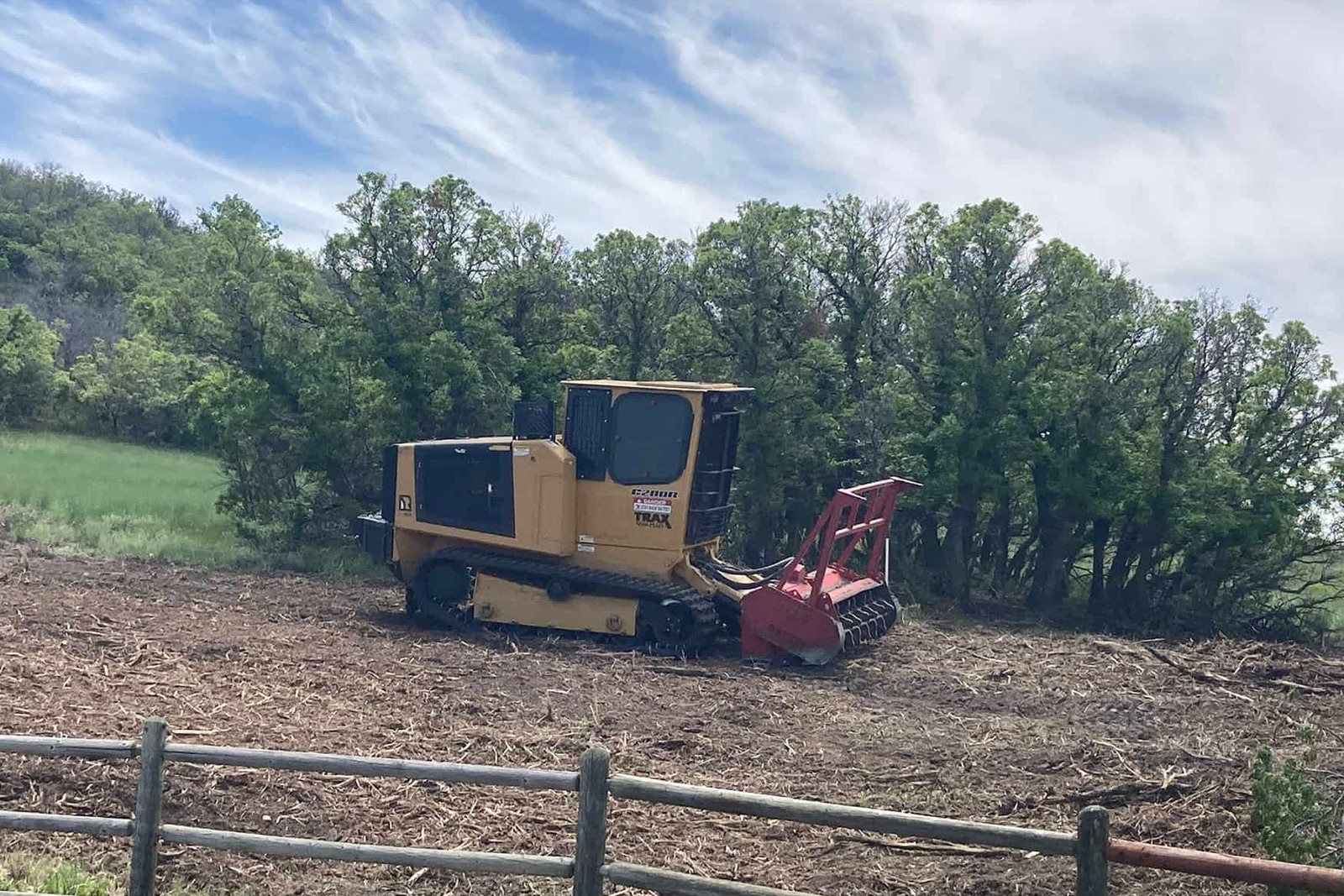
Acreage jobs vary too much to price sight unseen, so we start every Franktown project with a walkthrough. Bring your worries and your wish list. We'll flag the cuts that actually change your fire outcome, sequence them to fit a budget, and put the whole thing in writing. The mulcher grinds everything in place, which means no burn piles sitting next to your hay through a windy spring.
We're just up the road in Larkspur. Book through the mitigation quote page, and if the horses are out when we visit, we'll keep the gates as we found them. Cash or check when the work's done.
Free Quote · No Obligation
Clear the fuel before fire season, not during it
Or call the shop: (719) 400-9104