
Creating Defensible Space in El Paso County
El Paso County holds four different kinds of fire country inside one boundary line, from Black Forest ponderosa to the canyon walls of Ute Pass. We cut defensible space across all of it with one tracked mulcher and a working knowledge of which fuel does what.
COUNTY SCALE
Four Fuel Types, One County
Drive El Paso County end to end and you cross more fire regimes than most states own. The Palmer Divide carries dense ponderosa through Black Forest and up toward Monument. The western edge climbs into Ute Pass, where steep canyons funnel wind through mixed conifer and oak. The city's western rim is scrub oak interface, mile after mile of it. And east of Powers the county opens into shortgrass prairie, where fire moves at highway speed but burns past in minutes.
Each fuel demands different work. Grass wants mowed buffers and clean fence lines. Oak wants mastication and a return schedule. Ponderosa wants crown spacing. Canyon ground wants everything, wider, on the downhill side. A contractor who cuts every lot the same way is treating one of these four correctly and getting the other three wrong.
ACREAGE
Rules of Thumb for Unincorporated Parcels
Much of the county's fire risk sits on unincorporated land: the 5-to-40-acre parcels around Black Forest, Falcon's edges, Hanover, the benches above Ute Pass. No city code tells you what to cut out there, so here's the working guidance we give owners standing on their own dirt.
- Treat the first 100 feet around every structure as non-negotiable, and stretch it downhill on any slope
- Give your driveway enough width and overhead clearance for a fire engine, because a truck that can't reach you can't help you
- Thin the whole parcel if budget allows, but never let perfect stall the first hundred feet
- Put outbuildings, propane tanks, and hay on the schedule along with the house
- Plan on a light maintenance pass every two to three years, since oak and grass both come back
That list has held up across a few hundred county jobs. Start at the house and work outward until the money runs out. It's the right order every time.
One more county habit worth copying: several fire protection districts here run chipping days and cost-share programs for private mitigation, and they're worth a call before you spend a dollar. We'll point you toward what applies to your address when we walk the parcel. Free help for cutting fuel doesn't stay unclaimed long, so ask early in the year.
GEOGRAPHY
Divide Timber, Canyon Wind, and the Right Machine
The northern county is where we do our heaviest thinning. Black Forest already showed what continuous ponderosa does with a wind-driven start, and the unburned stands around the 2013 scar are still carrying the same fuel loads today. West of the Springs it's a different problem: Cascade, Chipita Park, and Green Mountain Falls hang on canyon slopes where fire runs uphill through oak into conifer, and where clearance below the house matters twice as much as clearance beside it.
We adjust the machine work to match. Flat divide ground gets systematic crown spacing. Canyon lots get aggressive downslope cuts and ladder-fuel removal. Grass country gets wide masticated buffers around structures and along fences.
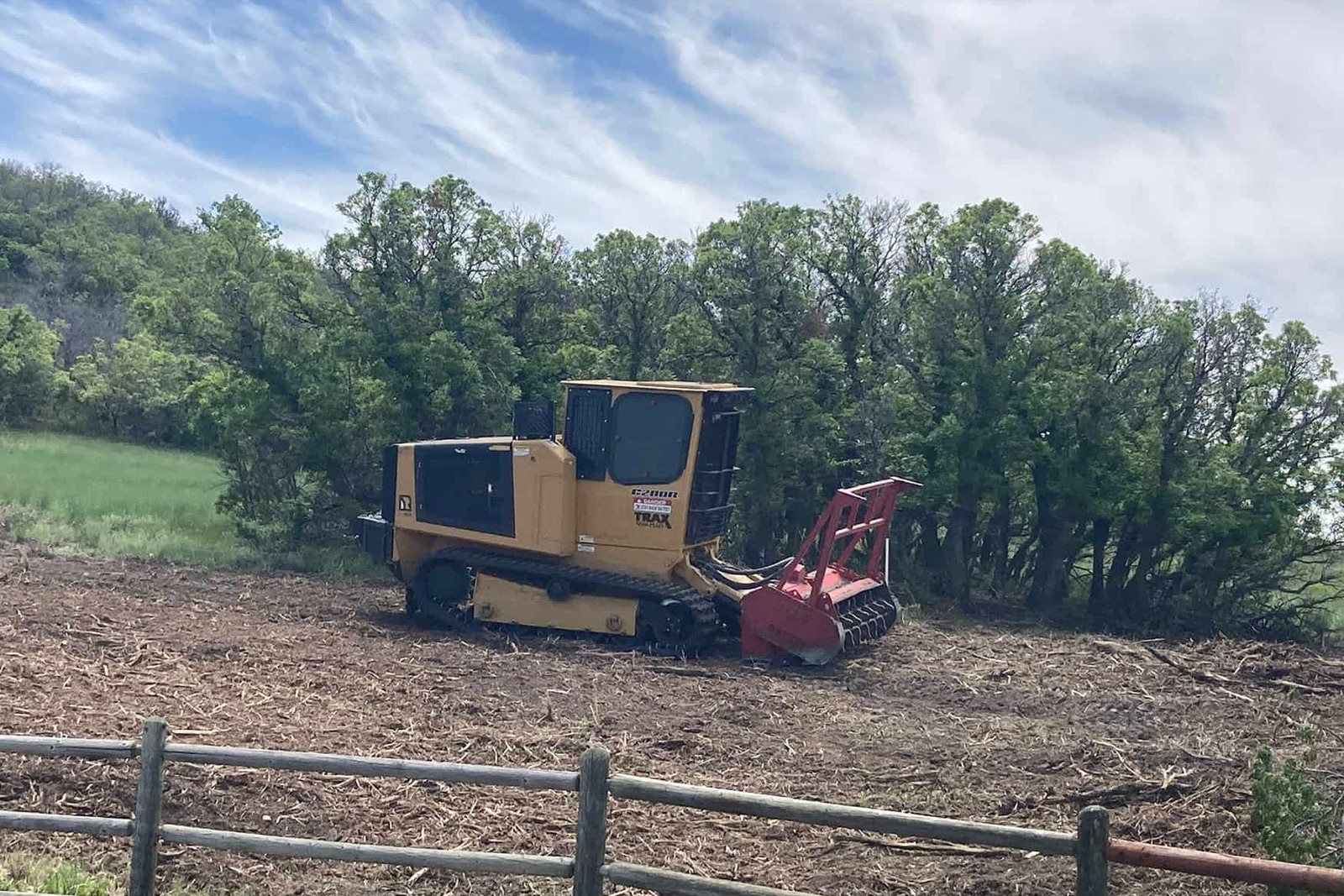
Big parcels bury hand crews. A saw crew leaves slash that has to be piled, permitted, and burned, and on 20 acres that's a second project costing as much as the first. The mulcher closes the loop in one pass: standing fuel becomes ground mulch, the soil stays covered, and there's nothing left to haul or torch. Cost per acre drops as parcel size grows, which is exactly backwards from hand-crew pricing, and exactly right for county acreage. See the range of past work on our projects page.
The machine is tracked, so wet spring ground and steep benches don't stop the schedule. One operator runs it, the same one who walked your land and wrote your number.
WIND
Chinook Days Set the County's Fire Clock
El Paso County's worst fire weather isn't a July afternoon. It's a winter or spring chinook event, when downslope winds gust past 60 on the Divide, humidity drops through the floor, and every fuel that cured last fall is ready to run. The county's red flag days cluster in the cold months, which surprises newcomers and explains why local fires have started in every season on the calendar. Fuel condition, not the date, is what matters, and cured grass under wind is condition enough.
This rearranges the mitigation calendar in your favor. There's no wrong season to cut, and the shoulder seasons are often the best: the machine works frozen or dry ground well, our schedule is lighter, and the work is finished before the spring wind events instead of after them. It also argues hard against burn piles, which sit on your land waiting for a legal burn window while chinook season blows past. Mastication produces no piles, so there's nothing on your property that needs weather permission to be safe.
If a wind event has ever made you stand in the yard and look west, that instinct is correct. Act on it in the calm months.
START
Getting a County Lot on the Books
We're based in Larkspur, minutes from the county line, and El Paso County is the center of our service map along with the city itself. Our Colorado Springs mitigation page covers the urban side of the work. For everything outside the city, the process is a walkthrough, a written price, and a scheduled cut, usually within a few weeks.
Call (719) 400-9104 or use the quote form. Cash and checks. And if you're not sure which of the county's four fire countries your parcel sits in, that's the first thing we'll figure out together, standing on it.
Free Quote · No Obligation
Clear the fuel before fire season, not during it
Or call the shop: (719) 400-9104