
How to Create a Defensible Space for Your Colorado Home You Can Live With
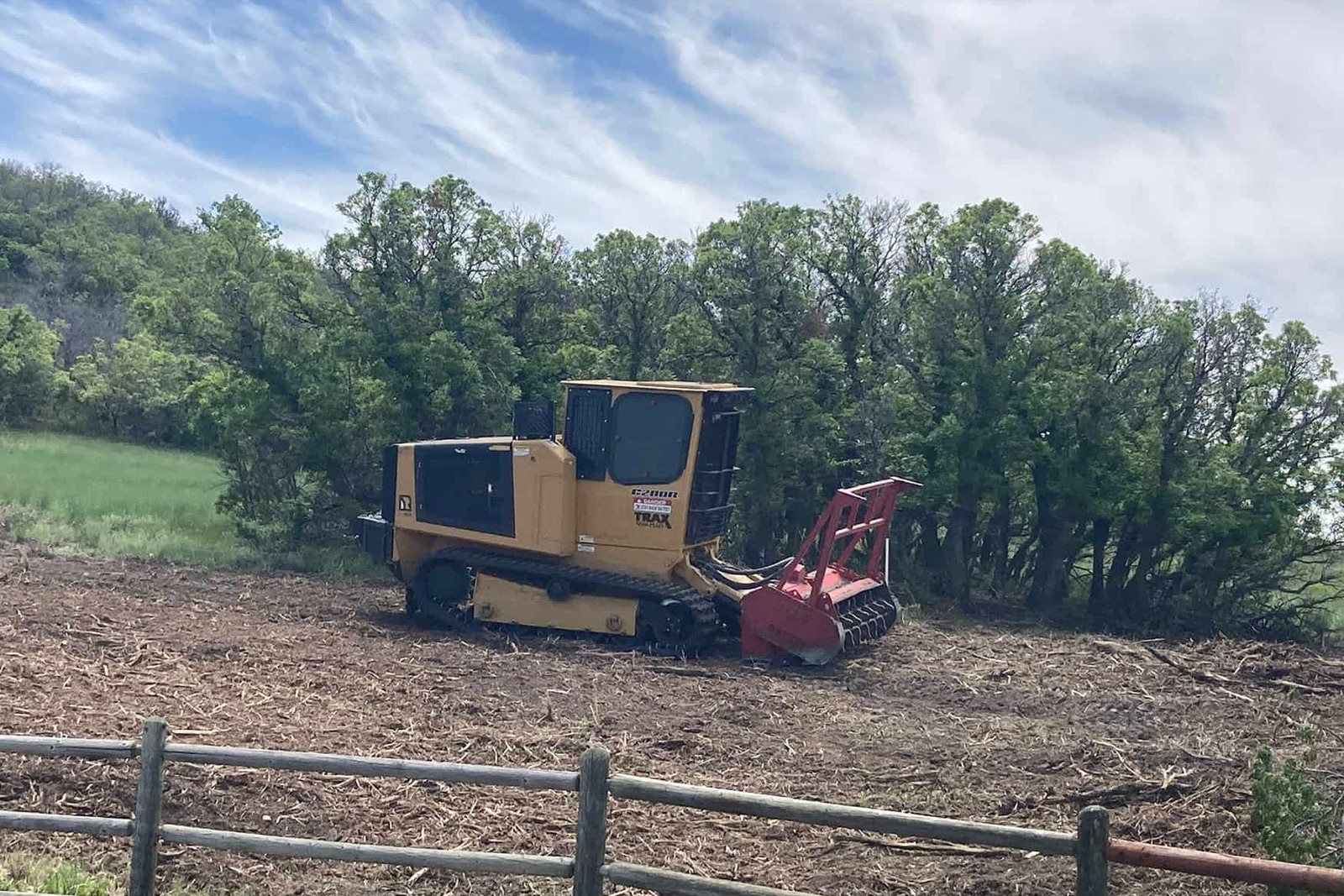
Defensible space doesn't mean clearcutting your land into a parking lot. Colorado's three-zone model keeps the trees you love and removes the fuel that connects them to your house. We run a tracked forestry mulcher anywhere in the state the job is big enough to justify the haul.
ZONE 1
The First 30 Feet Do Most of the Work
The Colorado State Forest Service model starts at your walls and works outward. Zone 1 is everything within 30 feet of the structure, and it's where the standards are strictest because most homes ignite from close-range fuel, not from a wall of flame rolling out of the forest. Embers land in a juniper bed. A woodpile against the siding catches. Flame walks up an oak clump into the eave.
In this zone we remove nearly all flammable vegetation, limb the trees you're keeping up to 10 feet, and eliminate ladder fuel, meaning anything that lets a ground fire climb into a canopy. Grass stays short. Shrubs near the foundation go. It sounds severe on paper. In practice, a well-executed Zone 1 reads as tidy landscaping, and you stop noticing what's missing within a month.
ZONES 2 AND 3
Zones 2 and 3: Break Continuity, Then Manage the Forest
From 30 to 100 feet, the goal shifts from removal to interruption. Fire spreads by continuity: crown to crown overhead, shrub to shrub at waist height, and from the ground into the trees wherever branches hang low over brush. Zone 2 work breaks all three chains. We thin so crowns have roughly 10 feet of separation, more on slopes, and we masticate the understory into scattered islands instead of a connected mat.
Done right, a crown fire entering Zone 2 loses its ladder, drops to the ground, and arrives at Zone 1 as something firefighters can actually engage. That's the entire strategy in one sentence. You're not fireproofing the land. You're changing the kind of fire that can reach your home.
Zone 3 runs from 100 feet to your property line, and here the work looks like general forest management: thinning overstocked stands, removing dead and diseased trees, favoring the healthiest specimens, and keeping total fuel load reasonable. On a small lot Zone 3 barely exists. On 35 acres it's most of the job, and it's where mastication really outruns hand crews on cost per acre. Our forest thinning page covers this scale of work in detail.
A healthy, thinned Zone 3 also pays dividends beyond fire. The remaining trees get the water and light, beetle pressure drops, and grass returns under the opened canopy. Most owners like their land more after thinning than before it.
TERRAIN
Slope Rewrites Every Distance
All the zone distances assume flat ground, and Colorado ground rarely cooperates. Fire preheats the fuel above it, so it accelerates uphill. A house on a slope needs its downhill clearances stretched, sometimes doubled, because that's the direction a fire arrives with the most energy. Draws and saddles funnel wind and flame. And the fuel itself changes by region: grass on the eastern plains moves fast and burns short, pinyon-juniper in the south torches violently, Palmer Divide ponderosa carries crown fire, and high-country spruce holds fuel from dirt to tip.
So the model is a starting point, not a stencil. We adjust the distances and the intensity of the cut to the slope, the fuel type, and the wind exposure of each specific lot. That judgment is what you're actually hiring.
THE FINISH
Chips on the Ground Beat Bare Dirt
How the fuel leaves matters as much as that it leaves. Dozer clearing scrapes land to mineral soil, and Colorado punishes that: the first thunderstorm cuts gullies, the first dry summer fills the scar with cheatgrass and thistle, and in five years you've traded native brush for a flashier fuel that cures earlier and burns faster. Hand crews avoid the scraping but leave slash, which is a fire hazard stacked on your property until somebody pays to pile, permit, and burn it.
Mastication skips both failure modes. The material gets ground where it stands and drops as a chip layer that armors the soil, holds moisture, and shades out much of the weed flush. There's nothing to haul and nothing to burn, which also means no smoke complaints, no permit windows, and no pile smoldering through a red flag warning. The ground looks treated the day we leave, and it looks better a year later.
A thick chip bed is still organic material, so we feather the depth near structures and spread it thin where fire arrival is most likely. Placement is part of the craft.
STATEWIDE
One Operator, Willing to Travel
We're based in Larkspur and do most of our cutting along the Front Range, from the Springs up through Douglas County. But the machine rides a trailer, and for larger projects we'll go where the work is: mountain subdivisions, ranch ground, canyon properties, anywhere in Colorado a real mulching job makes the mobilization worthwhile. Check the service areas page for the regular circuit.
Travel jobs work best bundled. If your mountain HOA or road association can line up three or four properties for the same week, the mobilization cost spreads thin across all of them and the per-acre price starts looking like Front Range rates. One phone call to a neighbor is the cheapest mitigation tool there is.
Every job starts the same way regardless of the county. We walk the land with you, mark what stays, price what goes, and put it in writing. No crews rotating through your property, no subcontractors. The person quoting the work is the person in the cab. When it's done you'll have defensible space you can maintain, a mulch layer instead of slash piles, and a place that still looks like Colorado. Start at the quote page whenever you're ready.
Free Quote · No Obligation
Clear the fuel before fire season, not during it
Or call the shop: (719) 400-9104