
Roofs as Part of Defensible Space
Your roof catches the embers, but your yard decides what happens next. On the westside of Colorado Springs, where neighborhoods run straight into the foothills, we grind the fuel out of that critical hundred feet between the forest and your fascia boards.
EMBER CAST
The Fire Arrives by Air First
Long before flames reach a neighborhood, the wind delivers embers, sometimes from a mile out. They land on roofs, in gutters packed with needles, on anything horizontal and dry. A Class A roof sheds most of them. But embers that roll off the shingles drop into whatever grows at the foundation, and that's where roofs stop being the story and vegetation takes over. The shrub bed catches, flame stands up against the wall, and the house is lost to a fire that never touched the forest canopy.
This is why roof material and defensible space aren't competing priorities. They're two halves of one system. We handle the vegetation half: nothing flammable in the ember catch zones, no fuel path from the yard to the eaves.
WALDO CANYON
June 2012, and What Mountain Shadows Learned
Waldo Canyon had been burning in the mountains for days when the wind shifted on June 26, 2012, and pushed a firestorm down the canyon into Mountain Shadows. Hundreds of homes burned in a few hours, inside city limits, with a full evacuation and a massive firefighting response already in place. It was, at the time, the most destructive fire in state history. And it rewrote how this city thinks about its western edge.
The post-fire studies found what these studies always find. Homes with clean ember zones and separated fuels survived at higher rates than homes buried in vegetation, even next door to each other. Mitigation didn't guarantee survival. But it shifted the odds hard, and on a night like that, odds were everything.
The uncomfortable part is the calendar. The slopes that burned in 2012 have been regrowing for over a decade now, and scrub oak doesn't need long to rebuild a fuel bed. Meanwhile the neighborhoods rebuilt bigger and closer to the edge than before. That's no prediction, just the same board being set again, and the only piece a homeowner controls is the fuel on their own lot.
WESTSIDE
Neighborhoods That Back Straight Into the Foothills
Cedar Heights sits inside a gated canyon with one road out and native fuel on every side. Peregrine wraps around scrub oak draws that run downhill into the heart of the neighborhood. The rebuilt streets of Mountain Shadows still face the same slopes that burned in 2012, now covered in fifteen years of regrowth. These westside neighborhoods share a geometry: houses on the fire-facing edge of the city, with fuel running unbroken from public land to private fence.
We work that edge constantly. Our Colorado Springs fire mitigation page covers the full service list, but the core of it is mastication: oak, mahogany, and overgrown understory ground into mulch across the 30-to-100-foot band the fire behavior models care about most.
Wind out of the canyons is the multiplier. Waldo Canyon's worst hours came when outflow winds pushed fire downslope into the city, the direction nobody's mental model expected. So westside lots should take their uphill side seriously for exactly that reason: fire here doesn't only climb. It can arrive from above with the evening wind behind it.
THE CUT
Between the Forest and Your Fascia
A typical westside job runs in layers. Tight against the house, we clear to bare-minimum fuel: no shrubs under windows, no oak touching the deck, gutters and roof left for your ladder or your roofer. Out to 30 feet, we take the understory down and limb the pines. From there to the property line we thin for crown separation and grind the shrub layer into islands. Steep back slopes, the kind Peregrine and Cedar Heights are full of, get extra width because fire climbs.
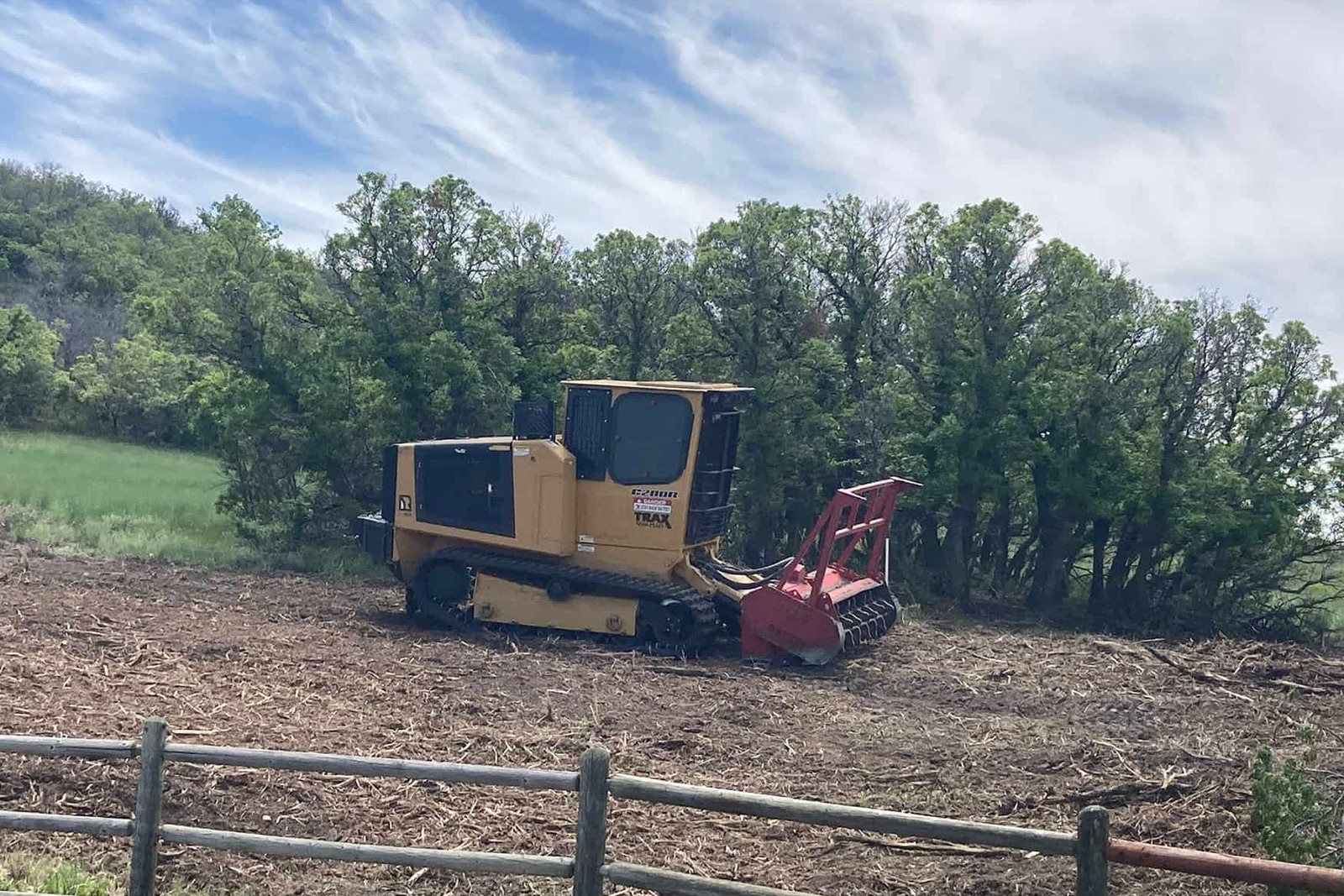
The machine is a tracked mulcher, so there's no slash to haul down your driveway and no burn pile smoking on a red flag day. Chips stay down, hold the slope, and slow the regrowth.
Most of the fuel above Colorado Springs is layered: Gambel oak and mountain mahogany growing chest-high to head-high underneath ponderosa and Douglas-fir. That vertical arrangement is called ladder fuel, and it's what converts a survivable ground fire into a crown fire. Flame stands up in the oak, reaches the low pine branches, and climbs. Once fire is in the crowns it moves faster than anything on the ground can chase, and it throws the ember volume that overwhelms neighborhoods.
Breaking the ladder is often more valuable than removing trees. We grind the oak understory out from beneath the conifers, limb the keepers up to 10 feet, and suddenly the same stand can carry a ground fire past your home without putting it in the canopy. On the canyon slopes behind Cedar Heights and Peregrine this work is worth double, because slope was already lengthening the flames before the ladder got involved.
It's satisfying work to see finished. The pines stay, the shade stays, the screen of green stays. What's gone is the connection between the ground and the sky.
BOOKING
Westside Scheduling and Straight Pricing
We're 35 minutes north in Larkspur and cut in the Springs year-round. Walkthroughs are free, prices are written, and most residential jobs finish in one or two days. If your street organizes several homes at once, everybody's number gets smaller. That's not a gimmick, it's just mobilization math.
The westside has already had its warning fire. The fuel grew back. Get on the schedule through the quote request page, or call (719) 400-9104 and tell us what you're looking at out the back window. Cash and checks, no financing games.
Free Quote · No Obligation
Clear the fuel before fire season, not during it
Or call the shop: (719) 400-9104