
Defensible Space in Castle Rock
Gambel oak follows the drainages, and the drainages run straight through Castle Rock's subdivisions. We grind the oak back from homes in The Meadows, Crystal Valley Ranch, and Castlewood Ranch so the green belt behind your fence can't hand a fire to your back deck.
OAK DRAWS
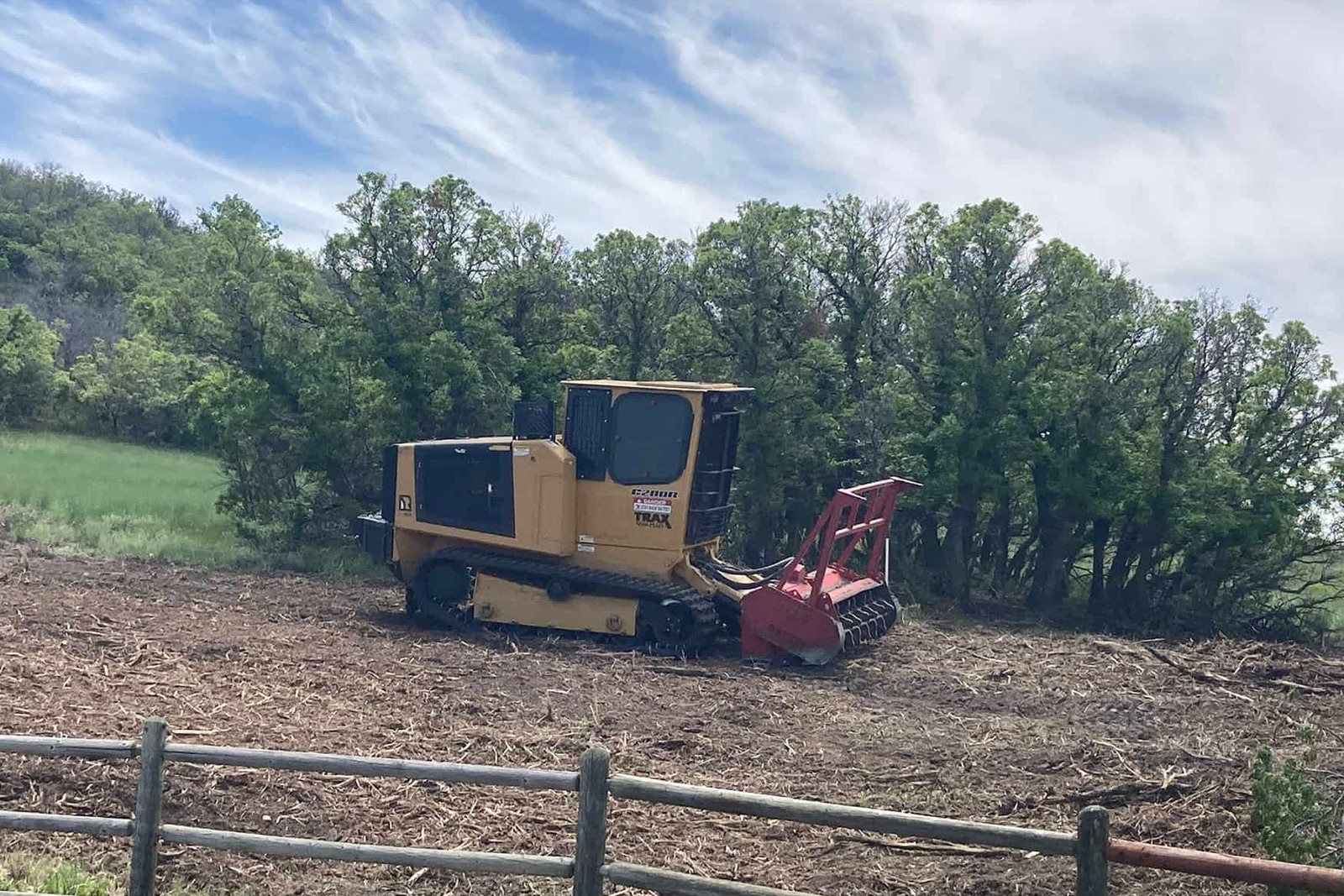
The Brush Follows the Water, and the Homes Follow the Brush
Look at Castle Rock from any of its buttes and you'll see the pattern. Ribbons of scrub oak trace every draw and drainage, and the subdivisions are built right up against them. Developers kept those corridors green on purpose. They're pretty, they carry the deer through town, and they raise property values. They're also continuous fuel beds running between hundreds of back fences, cured to kindling by late summer.
A fire that gets into an oak draw doesn't have to be big to be dangerous. Oak burns hot, throws embers, and regrows so densely that most stands haven't seen flame or a blade in decades. The fuel load per acre in a mature oak thicket surprises people. So does how fast it moves when the wind lines up with the draw.
The Meadows backs onto open ridges on the west side, where grass and oak mix and the wind comes over the top. Crystal Valley Ranch runs along oak-heavy slopes with real elevation change, which adds the uphill-fire problem to the fuel problem. Castlewood Ranch sits against big oak flats stretching toward Franktown. Three neighborhoods, three different versions of the same exposure: homes with a manicured yard in front and a wall of native fuel behind.
We've cut in all of them. The typical job is a band along the back of the lot, 30 to 100 feet deep where the property allows, grinding the oak into separated clumps instead of a solid mass and clearing everything within the first stretch off the fence and structures.
EDGES
Your Fence Line Against Town Open Space
A common Castle Rock question: the fuel behind my house is on town open space, so isn't it the town's problem? Legally, the town manages its ground and you manage yours. Practically, the fire doesn't check the parcel map. The defensible space that protects your house is the part you control, which means working your side of the line hard. Clean fence line, no oak touching the pickets, no shrub bed connecting open space to your landscaping.
Where HOAs control tracts of common oak, we've done coordinated cuts that treat a whole run of back fences at once. Splitting one mobilization across eight or ten homeowners drops the per-lot price a lot. If your HOA is talking about it, we're happy to walk the tract and put numbers on it.
REGROWTH
Managing a Plant That Refuses to Die
Gambel oak is a root system wearing branches. Cut it and it resprouts, every time, usually within the season. That's not a reason to skip the work. It's a reason to do the work with the right method. Mastication leaves a chip layer that visibly slows the resprout, and the regrowth that comes through is soft, low, and cheap to re-treat. A quick return pass every two or three years holds the line. We detail the full approach on our scrub oak removal page.
Compare the alternative: let it close back in for ten years and you're paying for the original job all over again. Maintenance is where defensible space is won or lost, and oak country makes that truer than anywhere.
SLOPE IN TOWN
Butte Country Tilts the Odds Toward the Fire
Castle Rock's signature topography works against its homeowners. The town is built on and between buttes and mesas, which means a large share of homes sit above slopes with fuel on them, and fire accelerates uphill. Flame lengths grow, spread rates multiply, and the preheated brush upslope is half-ignited before the fire even arrives. A house at the top of an oak-covered grade in Crystal Valley Ranch faces a fundamentally hotter, faster fire than the same house on flat ground in the same wind.
The fix is width where the physics demand it. On sloped lots we stretch the downhill clearances well past the flat-ground standard, sometimes to double, and we're more aggressive about reducing oak to low, separated islands on the fall line below the home. Uphill and side clearances matter too, but the downslope band is where the money should go first.
If you're not sure how your lot tilts, stand at your back fence and look down. Whatever you can see below you is the fuel that decides your fire.
Wind finishes what slope starts. The gaps between Castle Rock's buttes funnel the prevailing southwest flow, so the draws that carry the oak also carry the wind, in the same direction a fire wants to travel. When we plan a cut on butte-country ground we look at both: which way the land tilts and which way the wind runs down it. Where they agree, that side of the property gets the widest treatment, every time. Your prettiest view and your biggest exposure usually point the same direction out here.
GET A PRICE
Numbers Before Promises
Every lot in town is different, so we don't quote by the acre off the phone. We come look. You'll get a firm written price, a clear description of what's coming out and what's staying, and a schedule date. The machine does in hours what hand crews do in days, so most residential jobs wrap in a single visit. And the mulch stays, feeding your soil instead of filling a dumpster.
We're out of Larkspur, ten minutes down I-25. Request a walkthrough at the mitigation quote page, or call (719) 400-9104 if you'd rather talk first. Cash and checks accepted.
Free Quote · No Obligation
Clear the fuel before fire season, not during it
Or call the shop: (719) 400-9104