
Windows and Wildfires
Radiant heat cracks window glass before flames ever touch a wall, and pinyon-juniper country produces exactly the kind of short, violent heat that does it. We masticate PJ fuels around Canon City homes so that heat never gets close enough to matter.
WINDOWS
Glass Fails Early and Lets the Fire In
Here's the sequence nobody thinks about. A juniper torches 40 feet from the house. The radiant pulse hits a single-pane window, the glass shatters from thermal stress, and now there's an open hole into a room full of furniture with embers raining outside. The house burns from the inside out. Firefighters see this pattern constantly. The wall never caught. The window failed.
Distance is the fix, because radiant heat drops off sharply with every foot of separation. A shrub burning at 15 feet can break glass. The same shrub burning at 60 feet is a light show. That's what defensible space is actually buying you around Canon City: not a guarantee, but enough separation that the heat pulse arrives too weak to breach your openings.
While you're thinking about glass, look at the frames and coverings too. Dual-pane windows resist the heat pulse far better than single-pane, tempered glass better still, and a metal screen catches embers before they reach the sill. That's hardening work, so we don't sell it. But the cheapest window upgrade in the world is moving the fire farther away, and that part we do sell.
PJ FUELS
Juniper Doesn't Burn, It Detonates
Pinyon-juniper woodland behaves nothing like ponderosa forest. There's no clean ground fire creeping through needles. Juniper holds volatile oils in its foliage, keeps dead branches inside a live crown, and grows skirts right down to the dirt. When flame reaches one, the whole tree goes up in seconds, and it throws enough heat to light its neighbors from a distance. Pinyon isn't much better. So the spacing rules that work up north aren't enough down here.
In PJ country we cut wider gaps between trees than the standard Zone 2 guidance suggests, and we're aggressive about removing juniper entirely within the first 30 feet. Keep a favorite pinyon if it's isolated and healthy. But a juniper against the house is a barrel of fuel oil with a nice shape.
LOCAL GROUND
From Skyline Drive to the Dawson Ranch Edges
Canon City sits in a hot, dry pocket. The hills above Skyline Drive, the ridgelines around Dawson Ranch, the lots that back onto open BLM ground west and south of town: this is some of the driest fuel on the southern Front Range, cured hard by June most years. And where private land meets BLM, the fuel doesn't stop at the property pin. A fire crossing that line arrives with momentum.
For those edge properties we focus the heaviest cutting on the boundary side, building a masticated buffer where a grass and PJ fire loses its shrub component and drops to the ground. That's the difference between a fire your home survives and one it doesn't. Our completed projects include several of these boundary cuts.
METHOD
Spacing the Trees, Sparing the Soil
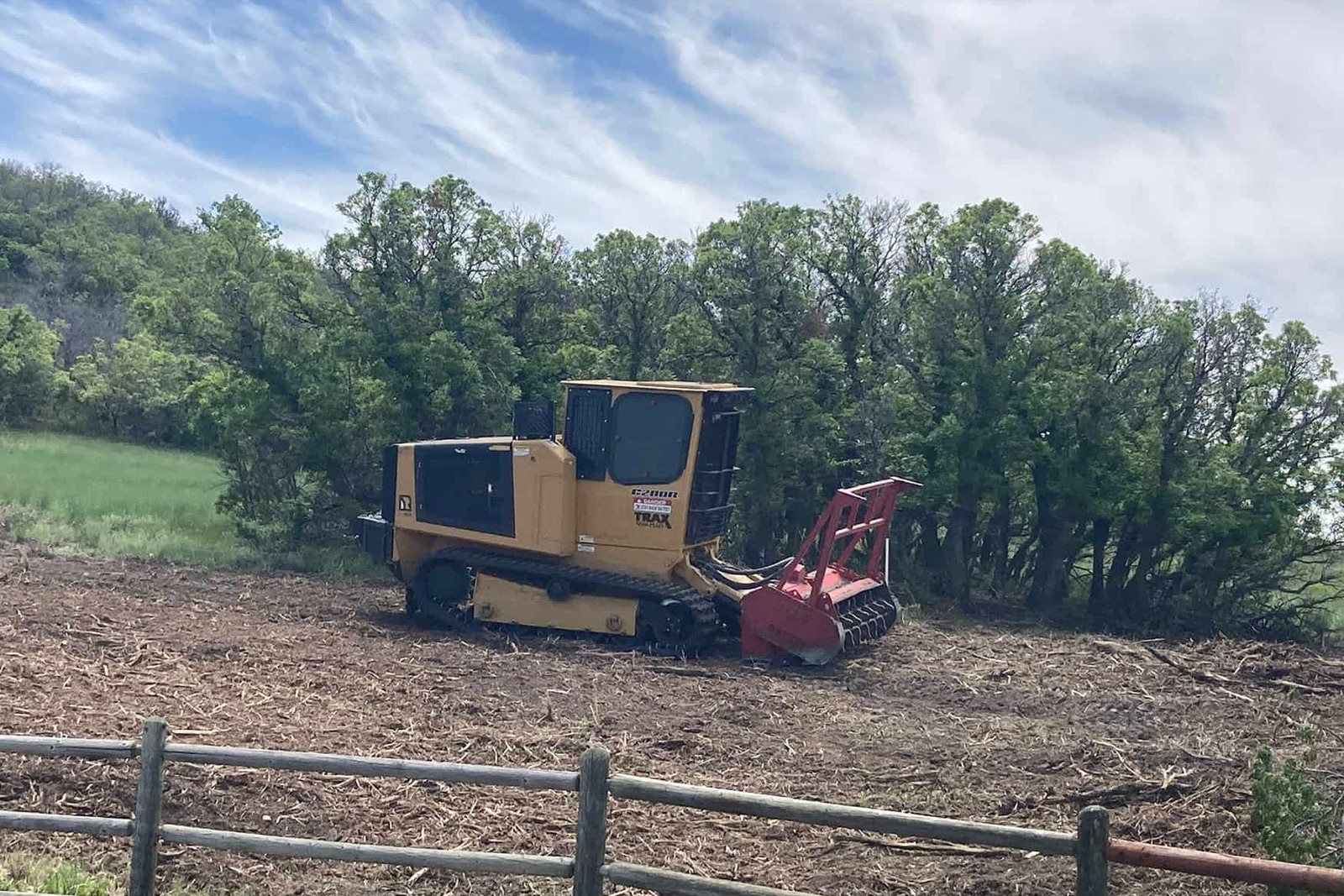
Soil around Canon City is shallow, rocky, and slow to heal. Scrape it bare with a dozer and you'll be looking at the scar, and the cheatgrass that colonizes it, for twenty years. The mulcher works differently. Trees and brush get ground standing, the chips drop in place, and the root structure stays in the ground holding what soil there is. The mulch layer shades the surface and slows the annual weeds that love disturbed ground.
One machine, one operator, tracks instead of tires. We get into steep, rocky corners that rubber-tired equipment won't touch, and we leave the ground looking treated rather than bulldozed.
Standard crown-spacing guidance was written for forests that burn along the ground most of the time. PJ isn't that. Because juniper torches whole and radiates hard, the working rule in this fuel is gap width measured in multiples of plant height: on flat ground, gaps two to three times the height of the surrounding trees, and wider as slope increases. A six-foot juniper needs 15 or 20 feet of clean air around it to stop handing fire to the next one. Stack that math across an acre and you understand why treated PJ looks sparse compared to treated pine.
Inside the first 30 feet we don't negotiate with juniper at all. It comes out. Pinyon can stay in small, isolated, well-pruned groups if you love a particular tree, positioned where its torching wouldn't load the house with heat. Past 30 feet, we thin toward islands: clumps of two or three trees with generous bare or grassy gaps between them, which keeps the land looking like the high desert instead of a lot cleared for construction.
Grass fills the openings within a couple of seasons, and grass fire in short, broken fuel is an event your cleared ring handles easily. That's the trade you're making, and it's a good one.
ESTIMATE
A Firm Number for Fremont County Work
We run down to Canon City from Larkspur regularly, and we price the drive into the job honestly instead of padding the hourly rate. Small Zone 1 cleanups, full-property PJ thinning, boundary buffers along BLM: it all starts with a walkthrough and ends with a written number you can hold us to. Payment is cash or check when the work's done.
Fire season in this valley starts earlier than the calendar says. If you've been staring at that wall of juniper on the west side of your lot for a couple of summers now, this is the year to deal with it. Ask for an estimate through the quote request page and we'll set a date to walk it.
Free Quote · No Obligation
Clear the fuel before fire season, not during it
Or call the shop: (719) 400-9104