
Vegetation in Defensible Space for Your Boulder Home
Boulder homes don't usually burn because a forest fire arrived. They burn because grass and shrub carried flame into the neighborhood faster than anyone expected. We masticate the shrub layer and open up the fuel on steep west-side lots so your vegetation works for you instead of against you.
GRASS FIRE
Marshall Settled the Argument About Grass
For decades the assumption along the Front Range was that real fire risk lived in the trees. Then December 30, 2021 happened. The Marshall Fire started in open grassland, rode a hundred-mile-per-hour wind into Louisville and Superior, and destroyed more than a thousand homes without ever touching a forest. Grass. Shrubs. Fences. Mulch beds. That's the fuel that took out entire subdivisions in an afternoon, in winter, with snow in the forecast.
So when we talk about defensible space in Boulder, we're not only talking about pine trees. We're talking about the continuity of everything that grows, from the tall grass at the edge of open space to the juniper against your foundation. Breaking that chain is the whole job.
SLOPE
West-Side Lots Fight Uphill Physics
Fire preheats the fuel above it, so it runs uphill fast and downhill slow. Pine Brook Hills, Sunshine Canyon, the streets stacked above Table Mesa: these neighborhoods sit on slopes where a fire starting below the house gets a running start. The standard guidance is blunt about this. Clearance below a structure on a slope needs to be wider than the same clearance on flat ground, because the fire arriving from downslope is hotter, taller, and moving.
On these lots we push Zone 2 work farther on the downhill side. Thin the shrub bands, break up the oak and ninebark patches, and take the ladder fuels out from under the ponderosa so a ground fire stays a ground fire. The tracked machine handles grades that would be miserable, slow handwork otherwise.
READING FUEL
Reading the Fuel and Choosing the Tool
Vegetation isn't one category. On a typical Boulder property we're looking at three different fires waiting to happen. The grass carries flame quickly but burns cool and short. The shrub layer, mountain mahogany and wild plum and sumac, burns hotter and longer and is tall enough to torch low branches. And scattered conifers hold the kind of heat that breaks windows and lights decks. Each layer needs a different treatment.
- Grass: mow or graze short within 30 feet, especially before wind season
- Shrubs: masticate into separated islands instead of continuous bands
- Trees: limb to 10 feet and open the crowns so one torching tree can't hand fire to the next
Get those three layers disconnected from each other and from the house, and you've changed what a fire can do on your lot. Leave them connected and the best roof in the world won't save you.
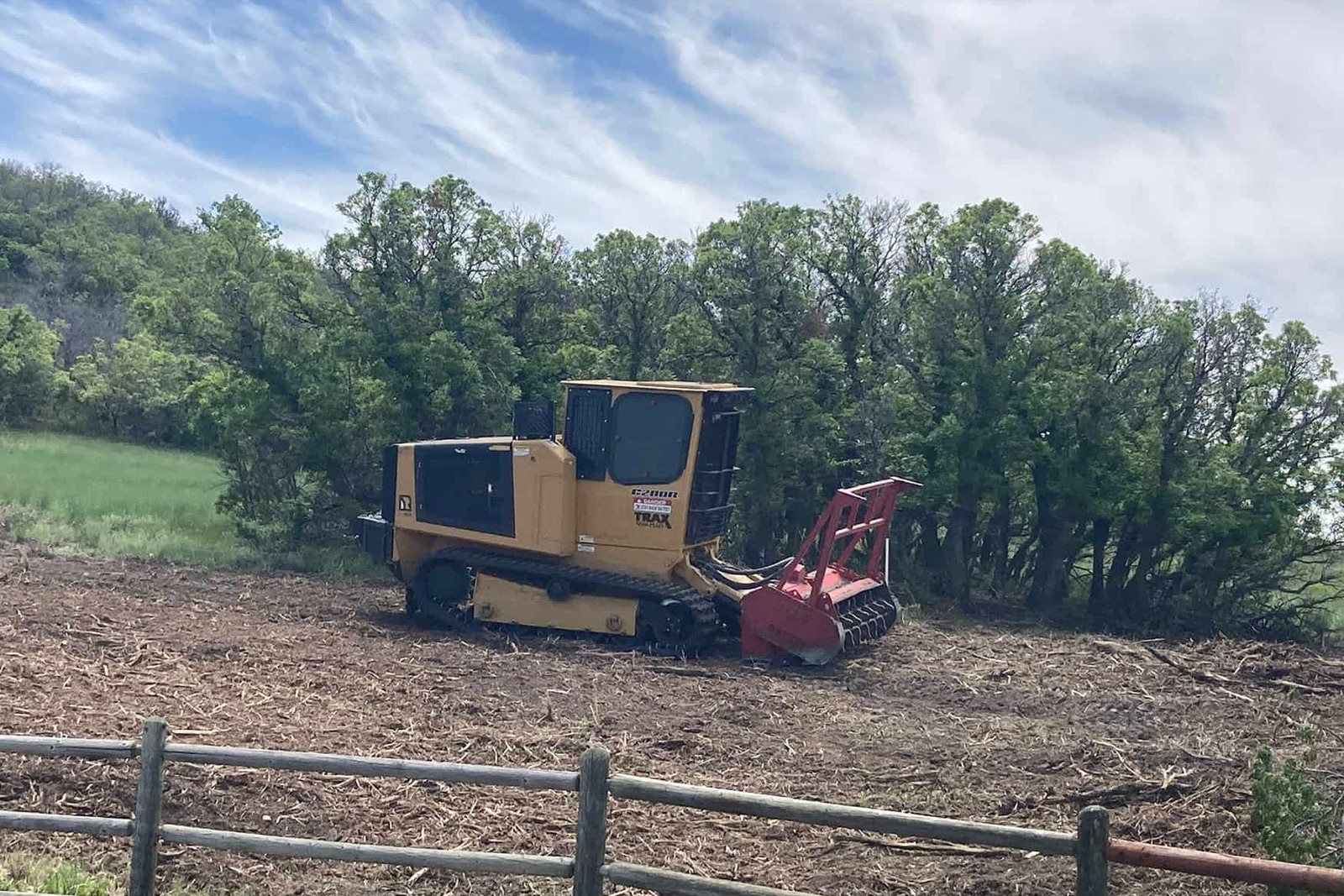
A crew with saws cuts brush and leaves you with slash, and slash is worse fuel than what you started with until it's hauled or chipped or burned. Our forestry mulcher grinds the standing shrub into chips in a single pass and leaves them on the ground as a mat. On Boulder's steep, thin-soiled lots that mat matters. It holds the slope, keeps the soil biology intact, and suppresses the flush of weeds that follows bare scraping.
It's also fast. A shrub field that would take a hand crew a week comes apart in a day. You can see the before and after on our brush clearing page.
THE ZONES
Mapping the Standard Rings Onto a Foothills Acre
The state's three-zone framework still applies in Boulder, it just needs translating. Zone 1, the 30 feet nearest the structure, is where foothill homes are weakest: decks cantilevered over downhill shrub fields, native plantings carried right up to the walls, firewood stacked under the stairs. We clear that ring hard. Zone 2, out to 100 feet, is where the shrub bands get broken into islands and the tree crowns get separated, with the downhill side treated widest because that's the approach direction on a west-side lot.
Past your property line the fuel usually belongs to someone else, often city or county open space. You can't cut it, but your cleared zones still do their job: a fire arriving from public land hits your treated ground and loses its structure before it reaches the house. And it's worth a phone call to the agency anyway. Boulder's land managers run their own fuel projects, and adjacent-owner interest genuinely influences where those happen.
The zones aren't a legal requirement on most county lots. They're just the difference between a property that gives a fire what it needs and one that doesn't.
A note on looks and wildlife, since Boulder owners always ask. Thinned shrub islands still shelter the towhees and feed the deer. What changes is connectivity for flame, and most lots honestly look better opened up: more grass, more wildflowers, longer sight lines down the slope. And if your home went through a county wildfire review at permit time, dig out that site plan before we cut. The clearances drawn on it are commitments, and we can build the work to match them exactly.
SCHEDULING
Beat the Wind Season, Not the Fire
The dangerous months in Boulder County aren't only July and August. Marshall burned in December. The chinook winds that pour off the Divide can drive fire any month the fuel is cured, which means the smart time to cut is whenever the ground is workable, not the week a fire is on the news. We schedule Boulder work in blocks to make the drive up from Larkspur worthwhile, so flexible timing gets you a better rate.
Start with a walkthrough. We'll flag the fuel that actually threatens the structure, tell you what can stay, and put a firm number on the rest through the quote page. Cash or check on completion. No surprises in between.
Free Quote · No Obligation
Clear the fuel before fire season, not during it
Or call the shop: (719) 400-9104