
Decks and Wildfires and Defensible Space in Black Forest Home
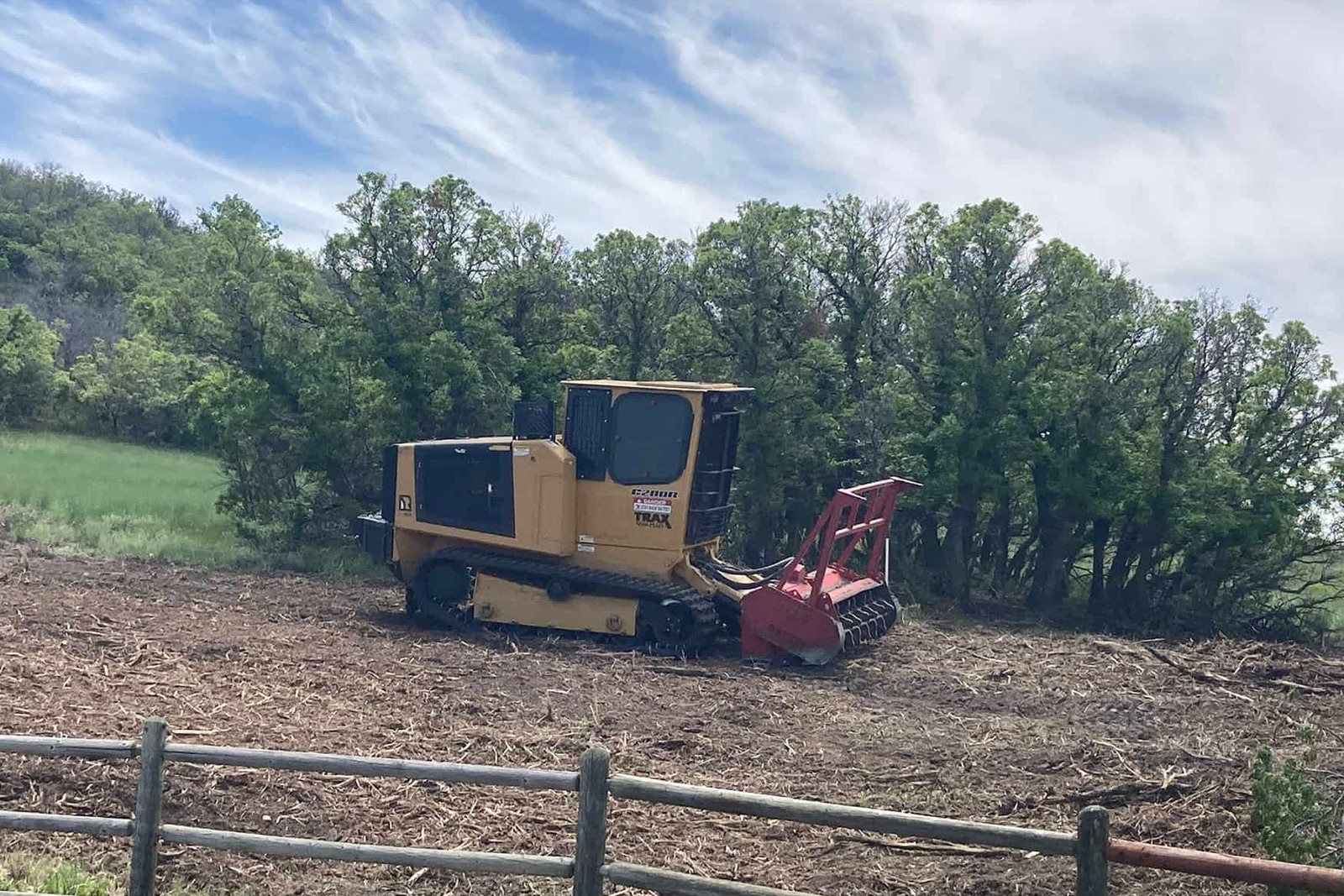
A deck is a fuel bed bolted to the side of your house, and in Black Forest most decks look out over ponderosa that has already burned once. We grind brush and thin trees with a tracked mulcher so the next fire runs out of fuel before it reaches your lumber. One operator, one machine, no burn piles.
THE 2013 FIRE
What the Black Forest Fire Left Behind
In June 2013 a fire started near the middle of this community and ran through the thickest ponderosa stand on the Palmer Divide. Roughly 489 homes were lost. Most of them sat on gentle ground, the kind of terrain people assume is safe. Black Forest isn't steep. It didn't matter. The fuel was continuous from Shoup Road to Burgess Road to Black Forest Road, crown touching crown, doghair thicket feeding doghair thicket, and the fire treated the whole forest as one connected burn.
The lesson wasn't subtle. Flat land with unbroken fuel burns just as completely as a canyon. What changed outcomes on individual lots was spacing. Where trees stood apart and the understory was clean, crews had something to work with. Where oak and young pine packed the gaps, they didn't. Thirteen years later the regrowth along those same corridors is coming back thick, and a lot of it is coming back as brush.
DECKS AND EMBERS
Why the Deck Goes Before the House Does
Embers travel a long way ahead of a flame front. They land on horizontal surfaces, and a deck is the biggest horizontal surface on most homes here. Needles collect between the boards. Firewood gets stacked underneath. Oak clumps grow right up to the drip line because nobody wants to lose the privacy screen. So when embers arrive, they find dry fuel touching the structure, and the deck carries fire straight into the wall.
Zone 1 work fixes this. That's the first 30 feet out from the structure, and it's where we're pickiest. We take out the shrubs under and around the deck, grind the oak back off the drip line, and limb the pines so there's no ladder from the ground into the canopy. You keep shade trees. You lose the fuel that connects them to your house.
ZONE WORK
Thinning Ponderosa and Keeping the Oak Down
From 30 to 100 feet out, the job changes. We're not stripping the lot. We're breaking continuity. The Colorado State Forest Service calls for about 10 feet between crowns in Zone 2, more if you've got any slope working against you, and in Black Forest that usually means removing the weak, suppressed trees that grew up in the shade of the big ones. The forest that's left looks like the forest people moved here for. Open, parklike, dominated by mature ponderosa.
The mulcher does this without disturbing the ground. Every stem we cut gets ground into chips and spread where it fell. That layer holds soil, keeps moisture in, and shades out a surprising amount of regrowth. There's nothing to haul, nothing to burn, no slash pile sitting on your property waiting for a permit window.
Gambel oak resprouts from the roots after cutting. Anyone who tells you otherwise hasn't cut much of it. What mastication buys you is a manageable problem instead of an impossible one: the mulch layer slows the resprout, and when it does push through, a return pass every few years knocks it flat for a fraction of the original cost. Compare that to scraping the ground bare, which invites erosion and thistle and gives you a moonscape until something worse grows back.
We set up return cycles for a lot of Black Forest properties. First pass does the heavy work. After that it's maintenance, quick and cheap, and your defensible space actually stays defensible instead of quietly closing back in.
FOREST HEALTH
An Open Stand Is a Healthier Stand
Defensible space gets sold as a fire product, but the forest itself is the other beneficiary. Black Forest ponderosa is badly overstocked in most unburned pockets, with hundreds of stems per acre competing for water that comfortably supports a fraction of that. Thin the stand and the keepers respond within a season or two: better needle color, more cone production, real resistance when the next drought or beetle cycle arrives. Grass and wildflowers return to ground that hasn't seen direct sun in decades.
On lots inside the burn scar, the question flips. The young regeneration coming up since 2013 is dense, and dense young pine becomes the next doghair thicket on a thirty-year clock. Spacing saplings now costs almost nothing. Spacing the same trees at forty feet tall costs real money. If you're replanting or managing natural regrowth, build the spacing in from the start and your future self inherits an open stand instead of a project.
And the look wins people over. Nearly every owner who hesitates before thinning tells us afterward the property feels bigger, brighter, and more like the forest they thought they were buying.
NEXT STEP
Walking Your Lot Before Fire Season
We're based in Larkspur, about twenty minutes up the road, so getting to Black Forest is easy and there's no mobilization surcharge for the trip. The estimate works like this: we walk the property with you, flag what goes and what stays, and give you a number. No pressure after that. Some owners do the whole lot at once. Others start with Zone 1 and the deck line, then book Zone 2 for the following season.
And if you're rebuilding on a burned lot, the standards are worth building to from day one. It's far cheaper to keep a young forest open than to reopen an old one. Request a visit through our mitigation quote page, look over past work on the projects page, or call (719) 400-9104. We take cash and checks, and we answer our own phone.
Free Quote · No Obligation
Clear the fuel before fire season, not during it
Or call the shop: (719) 400-9104